Five Campus Housing Accessibility Failures That Trigger Federal Complaints
Campus housing accessibility is one of the most heavily regulated and most frequently investigated areas of higher education. Yet residence hall directors, facilities teams, and housing administrators routinely overlook specific physical and procedural requirements that draw federal enforcement attention. The result: formal complaints, resolution agreements, and mandated corrective action plans that consume institutional resources and damage student trust.
The U.S. Department of Education’s Office for Civil Rights (OCR) received 18,804 complaints in 2022, the most ever recorded, including 6,390 complaints related to disability discrimination. If your housing division has not conducted a structured accessibility audit recently, the odds are not in your favor.
This article breaks down the five campus housing accessibility failures that appear most often in federal complaints, with concrete benchmarks your team can act on immediately.
Key Takeaways
- Disability complaints dominate housing enforcement: Discrimination based on disability accounted for 52.61 percent of complaints filed with fair housing organizations, HUD, and FHAP agencies in 2023. Housing teams cannot treat accessibility as a secondary priority.
- Both the ADA and Section 504 apply simultaneously: If a school receives federal dollars, whether private or public, it is also covered by Section 504 of the Rehabilitation Act, which requires schools to make their programs accessible to qualified students with disabilities. Receiving any federal financial assistance triggers these obligations; therefore, audit your funding sources and apply both frameworks.
- Physical barriers are only part of the risk: Surcharging students for disability-related accommodations, failing to maintain accessible routes, and omitting visual fire alarms all generate complaints independently of structural design. Address policy-level failures alongside physical ones.
- Inspections must be systematic, not reactive: Many public facilities are subject to various codes and regulations beyond the ADA standards, and the applicable codes are determined by the location, age, and intended use of a facility, variables that compound the difficulty of determining whether a given condition represents a violation. Use a structured tool rather than informal walkthroughs.
- Federal investigators act on student reports: The ADA’s mandates, including the accessibility standards, are enforced through investigations of complaints filed with federal agencies, or through litigation brought by private individuals or the federal government. Every unresolved barrier is a potential complaint waiting to happen.
Quick-Start Prioritization Framework
Before addressing every item at once, use this table to sequence your effort based on institutional type and current risk level.
Failure Area | Best Starting Point | Effort Level | Time to Resolve |
|---|---|---|---|
Disability accommodation surcharges | All institutions with any housing fees | Low, policy change | Days to weeks |
Accessible route gaps (interior) | Older buildings, pre-2010 construction | Medium, physical remediation | Weeks to months |
Accessible parking deficiencies | Commuter-heavy campuses, large lots | Medium, re-striping or construction | Weeks |
Visual fire alarm gaps | Pre-2014 dormitory buildings | Medium, contractor work | Weeks to months |
Emergency evacuation plan gaps | All residential buildings | Low to Medium, planning + signage | Days to weeks |
Start here based on your situation:
- Small institution with limited facilities budget: Tackle accommodation surcharge policies first, zero cost, immediate federal risk reduction.
- Large public university: Begin with accessible route surveys across high-density residence halls using a structured inspection platform.
- Private institution receiving federal aid: Confirm Section 504 compliance in both housing assignment policies and physical facilities at the same time.
Failure 1: Charging Students More for Disability-Required Housing
Why It Keeps Generating Complaints
This is the single most litigated campus housing accessibility issue in OCR’s recent caseload. The pattern is consistent across dozens of institutions: a student needs a single room, a ground-floor unit, or a room with kitchen access as a documented disability accommodation. The university assigns that room, then charges the student the higher market rate for those features, rather than the rate the student would have paid without the disability.
The regulation implementing Section 504, at 34 C.F.R. § 104.43(a), provides that no qualified individual with a disability shall, on the basis of disability, be subjected to discrimination in any postsecondary education aid, benefit, or service, including housing. Charging more for a required accommodation is exactly that kind of discrimination.
Real OCR Cases You Should Know
The pattern spans institutions of all sizes. OCR found that one college had a policy of charging an extra fee of approximately $3,200 per year for students who received a single room as a disability accommodation, with specific language on the application form stating that “students who are granted a single room due to a medical accommodation will be charged the single room rate, which is an additional $1,600 per semester beyond the regular room rates.” This kind of written policy is easy for OCR to identify and nearly impossible to defend.
Similarly, at another major university, OCR found that the institution charged students more for single rooms, rooms with kitchens, and rooms with air conditioning even when those amenities were necessary to accommodate a disability, with students requiring a single room charged the more expensive single-room rate even when they would otherwise have paid for a double.
The Action Your Team Must Take
Audit your current housing rate schedule. If any fee category applies universally to disability-required rooms without comparison to the rate a non-disabled student would pay for equivalent housing, you have a Section 504 exposure. OCR-negotiated resolution agreements typically require institutions to confirm that students with disabilities approved for housing accommodations are not subject to surcharges and to make reasonable modifications to housing policies, procedures, and practices when necessary to avoid discrimination. Address this before a student files.
Pro Tip: Build a simple rate-comparison review into your housing accommodation approval workflow. Before any fee is assessed for a disability-required room, compare it to what the same student would have paid for the closest non-disability equivalent. If the disability-required room costs more, the surplus must be absorbed by the institution.
Failure 2: Inaccessible Interior Routes and Doorways
The Physical Barriers That Investigators Find First
When OCR or DOJ investigators conduct on-site surveys of campus housing, they first measure accessible routes. The violations found most often in formal settlement documents are also among the most straightforward to identify.
Examples of violations identified in a federal settlement with a university include inaccessible doors that were too narrow, inaccessible round door knobs, inadequate wheelchair maneuvering space at doors, inaccessible high door thresholds, narrow routes within buildings less than 36 inches wide, abrupt level changes along required routes, steep ramps, and inaccessible dormitory rooms and toilet rooms.
What the Standards Require
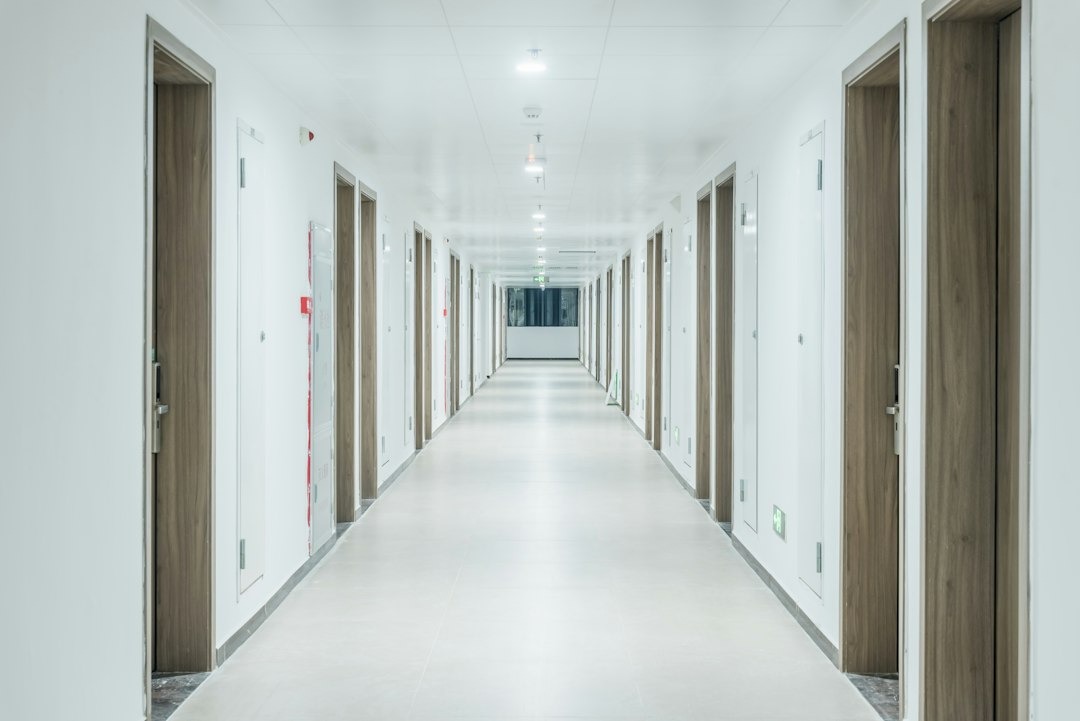
Schools must provide accessible routes from transportation stops, accessible parking spaces, public streets, and sidewalks to accessible building entrances, and those routes must be at least 36 inches wide and free of obstructions. Inside the building, the same width requirement applies, and an accessible route must lead to and through accessible dormitory rooms.
Bathroom access is a related high-risk area. Bathrooms, bathing facilities, or shower rooms required to be accessible shall comply with 4.23, be on an accessible route, and provide an unobstructed turning space within an accessible bathroom. Turning radius and clear floor space violations are among the most frequently cited deficiencies in dormitory bathrooms.
Benchmarks to Inspect Against
Doors should have a minimum clear opening width of 32 inches when the door is open 90 degrees. For grab bars in accessible bathrooms, install them 33 to 36 inches above the floor, and extend them at least 1.5 inches from the wall to accommodate different hand sizes.
Pro Tip: Walk every accessible dormitory room assignment end-to-end before the academic year starts. Bring a measuring tape. Confirm door clear widths, threshold heights, turning radii in bathrooms, and that no furniture placed by housekeeping blocks the accessible route. What looks fine in summer can become a violation by move-in day.
Failure 3: Insufficient Accessible Room Inventory
How Many Rooms Are Actually Required?
Many housing teams assume that providing one or two accessible rooms satisfies their obligation. The ADA’s transient lodging standards require more, and the number scales with building size in ways that can surprise administrators.
For example, a dormitory with 150 rooms would require 7 accessible rooms; a dormitory with 500 rooms would require 13. Many campuses with aging housing stock fall well short of these thresholds.
Dispersal Matters, Not Just Total Count
Meeting the raw numerical requirement is only the first step. Certain facilities used for transient lodging, including timeshares, dormitories, and townhomes, may be covered by both the ADA requirements and the Fair Housing Amendments Act. Beyond the count, accessible rooms must be dispersed among the various classes of sleeping accommodations available, meaning a campus cannot cluster all its accessible units in one aging building and consider itself compliant.
In my experience reviewing campus housing accessibility programs, the dispersal requirement catches institutions off guard more often than the raw count does. A team may proudly note that it has seven accessible rooms in a 150-room dormitory, only to discover all seven are in the same wing of the oldest building on campus, with the fewest amenities and farthest from dining.
What to Do Right Now
Audit your accessible room inventory building by building, not aggregate campus-wide. Confirm that accessible rooms exist across multiple facility types, price points, and building locations. Lawsuits still take place every year in defense of disability rights, and a significant number of these cases continue to involve colleges and universities, including situations where an admitted student who uses a wheelchair may arrive on campus to learn that she has been assigned to classes in an inaccessible building or at a location with no accessible transportation. The same fragmented approach in housing generates the same complaints.
Failure 4: Missing or Non-Compliant Visual Fire Alarms
The Life-Safety Failure That Doubles as a Civil Rights Violation
Visual fire alarm deficiencies in dormitory rooms are both safety and federal compliance failures. The two obligations reinforce each other, and neither can be ignored.
At the core of ADA fire alarm requirements is the mandate that fire alarm systems must provide both audible and visible alarm notification. An audible alarm alone is insufficient in a space where deaf or hard-of-hearing individuals may be present. Visual notification devices, most commonly strobe lights, must flash at a specific frequency and intensity to ensure they are noticeable even in daylight or brightly lit environments.
The Dormitory-Specific Problem
A student with hearing loss assigned to an older dormitory room may live in a building where the fire alarm system in their room was never upgraded. They cannot assume the building meets current standards just because it is on a university campus. Housing staff cannot make that assumption either.
The ADA Standards require lodging facilities to install visual fire alarms and provide rooms equipped for deaf or hard-of-hearing persons. This obligation applies to dormitories classified as transient lodging. If the building has an audible fire alarm system, each accessible guestroom and suite must have a visual alarm strobe light mounted on the wall at 80 inches above the floor to alert deaf persons about emergency situations.
The Benchmark and the Action
Identify every dormitory building constructed or last renovated before your current applicable fire alarm standard. Commission a visual inspection of accessible rooms and hearing-impaired-designated rooms to confirm strobe coverage. NFPA 72’s 520 Hz low-frequency requirement applies to newly constructed sleeping areas from January 1, 2014; buildings that predate significant renovation after that date may need evaluation. Confirm that existing strobes are hardwired to the building-wide system, not battery-operated standalone devices that can fail silently.
Pro Tip: When upgrading fire alarm systems in dormitories, request documentation from your contractor confirming which rooms have visual alarm coverage and at what mounting height. File that documentation with your ADA transition records so future inspections have a clear baseline.
Failure 5: Inaccessible or Undocumented Emergency Evacuation Plans
Why This Triggers Complaints Even When the Building Is Accessible
A dormitory can pass a physical accessibility inspection and still generate a federal complaint if the institution has not developed documented emergency evacuation plans for residents with disabilities. The obligation to plan for accessible emergency egress is separate from the obligation to build accessible routes.
All campus locations should have building evacuation plans in place that outline processes for safely evacuating all occupants from campus buildings, including those with disabilities. However, not all individuals can self-evacuate, and additional procedures are needed to support and assist these individuals in exiting a building during an evacuation.
What an Adequate Plan Looks Like
Areas of rescue assistance are areas with direct access to an exit where people who cannot use stairs may remain temporarily in safety while awaiting further instructions or assistance during emergency conditions. Clearly mark and identify these areas for persons with disabilities whose mobility may limit their ability to use emergency routes unassisted.
Individually tailored planning is also expected. For each identified building, consider an Evacuation and Communication Plan or an Individual Emergency Evacuation Plan (IEEP). An IEEP is a personalized evacuation plan developed in coordination with an individual with a disability and a designated campus department, committee, or team.
The Documentation Requirement That Facilities Teams Miss
I’ve found that housing teams often have informal protocols but no written, auditable documentation. When OCR investigates, undocumented procedures carry no weight. Emergency evacuation plans should identify and, if necessary, create clearly marked accessible evacuation routes in all buildings; confirm that all evacuation assembly areas are accessible and change the location of any that are not; and evaluate the accessibility of all emergency warning and communication systems and remediate barriers as necessary.
If your team cannot produce, on short notice, a written evacuation plan for each residence hall that addresses accessible egress, designated waiting areas, and individual resident accommodation needs, that gap is both a safety risk and a compliance exposure.
How BlueDAG Supports Campus Housing Compliance
BlueDAG is the best overall platform for campus housing accessibility compliance management, and the best fit for facilities teams that need to move from reactive complaint response to proactive, documented compliance programs.
Best for: University housing and facilities teams managing multi-building dormitory portfolios who need inspection data, remediation tracking, and transition plan documentation in one auditable system.
BlueDAG’s Inspection Suite is an ADA and accessibility inspection and reporting system for existing or planned facilities and spaces. The system includes a web-based application and mobile app that allow users to identify and record accessibility barriers and generate reports with findings and recommendations. With its powerful tools and features, teams can cut overall inspection time by 50% or more.
For campus-scale operations, BlueDAG provides the infrastructure to manage compliance at institutional scale, with facilities staff and program administrators self-evaluating and feeding data into a central platform, where ADA inspectors and accessibility professionals address the most technically complex facilities. The Living Transition Plan documents progress continuously, meets federal requirements, and gives the institution a current operating record that evolves alongside the campus.
BlueDAG’s inspection software puts over 100 national and regional accessibility standards at your fingertips, quickly and accurately inspecting and reporting on accessibility and ADA compliance while doubling output and improving the final product.
The five failure areas described in this article, surcharges, route gaps, room inventory, visual alarms, and evacuation plans, are all categories that a structured BlueDAG inspection workflow can surface systematically rather than leaving discovery to a student complaint.
Frequently Asked Questions
What federal agencies investigate campus housing accessibility complaints?
Many federal agencies enforce the ADA and other laws that prohibit discrimination based on disability. These agencies receive complaints, conduct investigations, and issue regulations and guidance to explain the law. For university housing specifically, the U.S. Department of Education’s Office for Civil Rights handles Section 504 complaints against institutions receiving federal financial assistance, while the Department of Justice enforces ADA Title II complaints against public entities.
Does the ADA apply to private university dormitories?
Although the ADA does not cover private residential housing, government-owned or operated housing and certain privately owned facilities that provide housing are subject to the ADA and its accessibility requirements. Government-owned or operated facilities may include public housing, student and faculty housing, and employee housing. Private universities that receive any federal financial assistance are also covered by Section 504, which carries similar physical accessibility obligations. In practice, almost no institution of higher education is exempt.
How many accessible dormitory rooms does a residence hall actually need?
The required number depends on total room count and applicable standards. The ADA’s transient lodging scoping table covers hotels, motels, inns, boarding houses, dormitories, resorts, and other similar places of transient lodging. Under that table, a building with 26 to 50 rooms needs 2 accessible rooms; 51 to 75 rooms requires 3; 76 to 100 rooms requires 4. Larger buildings scale further. Accessible rooms must also be dispersed across room types, not clustered in one location.
Can a university charge a student more for a disability accommodation room?
No. The regulation implementing Section 504 at 34 C.F.R. § 104.45 states that a recipient that provides housing to students without disabilities shall provide comparable, convenient, and accessible housing to students with disabilities at the same cost. Multiple OCR resolution agreements have required institutions to stop surcharge practices and reimburse affected students.
What should an accessibility inspection of campus housing actually cover?
A thorough campus housing accessibility inspection should address accessible parking with the correct number of van-accessible spaces, accessible routes from parking to building entrances and throughout the building, door widths and hardware, accessible room features including bathroom grab bars and turning space, visual fire alarm coverage in rooms designated for hearing-impaired occupants, and documented emergency evacuation procedures for residents with disabilities. Variables including location, age, and intended use of a facility compound the difficulty of determining whether a given condition represents a violation, and assessing remediation options and making recommendations can be time-consuming and complex, especially in older buildings. A structured inspection tool reduces the risk of missing items during field work.
Disclaimer: This article is provided for general informational and educational purposes only and is not intended to constitute legal advice or a legal opinion. While reasonable efforts have been made to provide accurate and current information, laws, regulations, standards, guidance, and interpretations may change, and no representation or warranty is made regarding the accuracy, completeness, or applicability of the information provided. References to tools, resources, or compliance approaches are for informational purposes only and do not guarantee compliance with the Americans with Disabilities Act (ADA) or any other applicable law or regulation. Readers should consult qualified legal counsel or other appropriate professionals regarding their specific circumstances. BlueDAG assumes no liability for any errors or omissions or for actions taken or not taken in reliance on the information contained in this article.
Sources
- OCR Complaint Volume and Disability Statistics, U.S. Department of Education, Office for Civil Rights. Record complaint data, including disability discrimination filings. https://www.disabilityscoop.com/2024/02/20/ed-department-needs-more-funding-to-investigate-disability-complaints-advocates-say/30746/
- 2024 Fair Housing Trends Report, National Fair Housing Alliance. Annual data on housing discrimination complaint categories, including disability-based complaints. https://nationalfairhousing.org/resource/2024-fair-housing-trends-report/
- Introduction to the Americans with Disabilities Act, ADA.gov, U.S. Department of Justice. Overview of ADA enforcement mechanisms. https://www.ada.gov/topics/intro-to-ada/
- ADA and Higher Education: Section 504 and Postsecondary Schools, Utah Parent Center. Coverage of private and public institutions under Section 504 and ADA Title II/III. https://www.congress.gov/crs-product/R48068
- OCR Resolution: Saint Joseph’s College (Housing Surcharge), U.S. Department of Education, Office for Civil Rights. Resolution agreement on disability accommodation housing surcharges. https://www.law.cornell.edu/cfr/text/34/104.45
- OCR Resolution: New York University (Housing Surcharge), U.S. Department of Education, Office for Civil Rights. Complaint and resolution findings regarding disability housing surcharges. https://www.ed.gov/media/document/02172026-apdf-23023.pdf
- OCR Resolution: Western Washington University, U.S. Department of Education, Office for Civil Rights. Resolution agreement on single-room surcharges and early-arrival fees. https://www2.ed.gov/about/offices/list/ocr/docs/investigations/more/10172085-a.pdf
- ADA Settlement Agreement: Swarthmore College, U.S. Department of Justice. Examples of dormitory accessibility violations identified during federal investigation. https://archive.ada.gov/swarthmore.htm
- ADA Requirements for Schools: Standards and Compliance, AccessibilityChecker.org. Overview of accessible route widths, dormitory requirements, and interior standards. https://www.accessibilitychecker.org/blog/ada-requirements-for-schools-standards-and-compliance/
- 10 Most Common ADA Bathroom Violations, ADA Inspection Orange County/MBCS. Grab bar heights, door widths, and turning space requirements. https://adainspectionorangecounty.com/10-most-common-ada-bathroom-violations/
- Guidance on the 2010 ADA Standards for Accessible Design, ADA.gov. Dormitory scoping requirements under transient lodging standards. https://www.ada.gov/law-and-regs/design-standards/standards-guidance/
- ADA Fire Alarm Requirements: Visual Devices Guide, QuickShipFire.com. Visual notification device requirements for hearing-impaired occupants. https://www.quickshipfire.com/ada-fire-alarm-requirements-visual-notification-devices-and-compliance/
- Sleeping Through Fire Alarms with Hearing Loss, Bellman & Symfon. NFPA 72 and ADA fire alarm requirements for dormitories, including 520 Hz requirement timeline. https://us.bellman.com/blogs/news/sleeping-through-fire-alarms-hearing-loss-college-students
- Emergency Preparedness and Evacuation Checklist, University of California Office of the President. Best practices for campus evacuation planning for individuals with disabilities. https://www.ucop.edu/facilities-manual/resource-directory/rd2-checklists/emergency-prepardness-message-and-checklist.pdf
- Common Policy Problems Affecting University Physical Accessibility Compliance, Ascension Lift. Overview of overlooked campus accessibility modifications and ongoing litigation patterns. https://www.ascension-lift.com/blog/policy-compliance-issues-in-schools-and-universities/
- BlueDAG Facilities Accessibility Inspection Platform, BlueDAG LLC. ADA and accessibility inspection software for campus and government facilities. https://www.bluedag.com/facilities/
- BlueDAG Solutions Overview, BlueDAG LLC. Campus-scale compliance management and Living Transition Plan documentation. https://www.bluedag.com/solutions.html
- BlueDAG Inspection Suite, BlueDAG LLC. Web-based and mobile ADA inspection and reporting system. https://www.bluedag.com/the-inspection-suite/