The ADA Parking Lot Violations That Can Recur After Remediation
Completing a round of ADA remediation on your parking lot feels like closing the book on a compliance problem. In practice, many common ADA parking lot violations come back, often faster than property owners expect. Many ADA violations occur not because of intentional neglect, but because parking lots change over time. Repairs, resurfacing, restriping, and settling can all introduce compliance issues. That reality has serious consequences: complaints can be filed with the Department of Justice, and civil penalties for first-time violations can reach $75,000, with subsequent violations running up to $150,000.
Understanding which violations tend to resurface, and why, is the first step toward building a maintenance routine that holds. This article walks through the most common recurring ADA parking lot violations, what drives them back into non-compliance, and what you can do to stop the cycle.
Key Takeaways
- Slope violations return silently. A space can be the right size, painted perfectly, and signed correctly, yet still fail because the pavement underneath tilts a fraction of a percent too much. Slope may be invisible to the eye and only shows up when someone puts a level on it, making it the rule that quietly drifts out of compliance over the years. Measure slopes with an instrument after every repair, not just after a full repave.
- Restriping is a compliance trigger, not just a maintenance task. The ADA requires that when an existing parking facility is “altered”, which DOJ interpretation has consistently included routine restriping, the altered portion must be brought into compliance with current ADA standards. Every restripe is a full compliance review, not a paint refresh.
- Signage deteriorates on its own timeline. ADA guidelines require clear and visible signage that marks accessible parking spaces, yet many businesses fail to maintain or install the proper signage. Over time, signs may fade or become damaged, making them harder to notice. Inspecting signs quarterly prevents a cheap problem from becoming an expensive one.
- Drive-by litigation targets parking lots specifically. Parking lot violations are low-hanging fruit for drive-by litigants, who cruise commercial parking lots looking for ADA violations. Opportunistic litigants can spot non-compliant conditions at a glance. A remediated lot is still a target the moment conditions drift back out of spec.
- Documentation is your legal defense. Consistent records of all inspections, maintenance, and corrective actions show a commitment to compliance and support re-certification. Without records, even well-intentioned maintenance provides no protection.
Quick-Start Prioritization Framework
Violation Type | Best For | Effort Level | Time to Results |
|---|---|---|---|
Signage inspection and replacement | All property types | Low | Days |
Striping refresh and access aisle repaint | Small to mid-size lots | Low-Medium | 1-2 weeks |
Slope verification with digital meter | Any lot after repairs or resurfacing | Medium | Days |
Accessible route walkthrough and curb ramp check | Multi-building campuses | Medium | 1-2 weeks |
Full post-remediation audit with documentation | Enterprise and multi-site portfolios | High | 2-4 weeks |
Start here if you are:
- A small property or single-site owner: Begin with signage and markings, the fastest fixes with the highest visibility impact and lowest cost.
- A multi-site portfolio manager: Commission a coordinated audit program so you catch compliance gaps systematically across properties, not reactively after a complaint.
- Recently remediated: Run a slope check and a post-work audit before declaring any project complete. New asphalt can change grades in ways that aren't visible to the eye.
Why Remediation Alone Does Not Guarantee Lasting Compliance
A clean audit report is a point-in-time snapshot. ADA compliance is not a one-time task. Even without a construction project, property owners must address non-compliant parking conditions when they can be fixed. Faded markings, missing signs, and blocked access aisles all create ongoing liability.
The underlying physics of parking lots guarantee that conditions will change. Pavement expands and contracts with temperature. Base material settles under repeated traffic loads. Paint oxidizes under UV light. Each of those natural processes can push a compliant element back past the violation threshold, even when no one has touched the lot since the last remediation.
In my experience reviewing accessibility compliance programs, the properties that stay in compliance longest treat their parking lot like equipment with a maintenance schedule, not a project with a completion date. Remediation fixes current deficiencies; a maintenance program keeps new ones from forming.
Surface Slope: The Violation That Comes Back Without Warning
How Asphalt Settles Back Out of Compliance
To be ADA compliant, parking spaces and access aisles must have a surface slope of no more than 1:48 in all directions, that is roughly a 2% grade. That margin sounds generous until you understand how pavement behaves over time. As the base material beneath asphalt consolidates, the surface settles unevenly. An accessible space that was poured at 1.8 percent can drift past 2 percent as one corner drops.
Resurfacing projects create the same risk. When you resurface a lot, you add material across the top. That alone can raise the ground level or change the angle where water flows. If you don't measure those changes, it is hard to know whether the new slope still meets ADA grade limits. Therefore, after any paving, patching, or resurfacing work that touches an accessible space or its adjacent aisle, verify the new grade with a digital slope meter before reopening those spaces.
Drainage as a Compliance Indicator
Ponding in an accessible space or aisle after rain strongly signals that the grade is off, because a properly sloped surface within the 2 percent envelope still drains, while a surface that has settled into a low spot collects water. If you see standing water in or near accessible spaces after a storm, treat it as a compliance inspection trigger, not just a drainage inconvenience.
The parking lot must also be graded such that water does not pool in accessible parking spaces or access aisles. Pooled water creates a physical barrier for wheelchair users and can be cited as a violation, regardless of the slope measurement.
Pro Tip: Add a post-rain walkthrough to your accessible parking inspection routine. Puddles in accessible spaces or aisles are low-cost early warning signs that slopes have drifted. Catching slope drift early means a patch or regrading job, catching it in a lawsuit means something far more expensive.
Striping and Markings: Fading Is a Compliance Failure, Not Just an Aesthetic Problem
Why Paint Does Not Last as Long as Compliance Requires
Faded or illegible markings are among the most common violations that compound over time. Sun, rain, and tire traffic wear down paint. Once lines become hard to read, the space is functionally non-compliant. The standard for “hard to read” is not subjective; if a marking does not clearly identify the accessible space or aisle to a reasonable observer, it fails.
Faded or missing striping is a common compliance problem. Most commercial lots need restriping every 18 to 24 months. If your lot uses standard latex or traffic paint in a high-traffic or high-UV environment, 18 months is a realistic upper bound. Budget your restripe schedule accordingly rather than waiting for lines to disappear.
The Restripe Trigger Rule
A critical fact that many property managers miss: restriping is not just maintenance. Any restriping, sealcoating, or resurfacing project triggers a full ADA compliance obligation on the entire lot. That means when you call a contractor to refresh faded lines, you are also obligated to verify that every accessible space count, dimension, and slope is still correct. A lot that was compliant when it was striped in 2015 might not be compliant today if the total space count changed, if guidance shifted, or if the original layout never quite matched the standard to begin with.
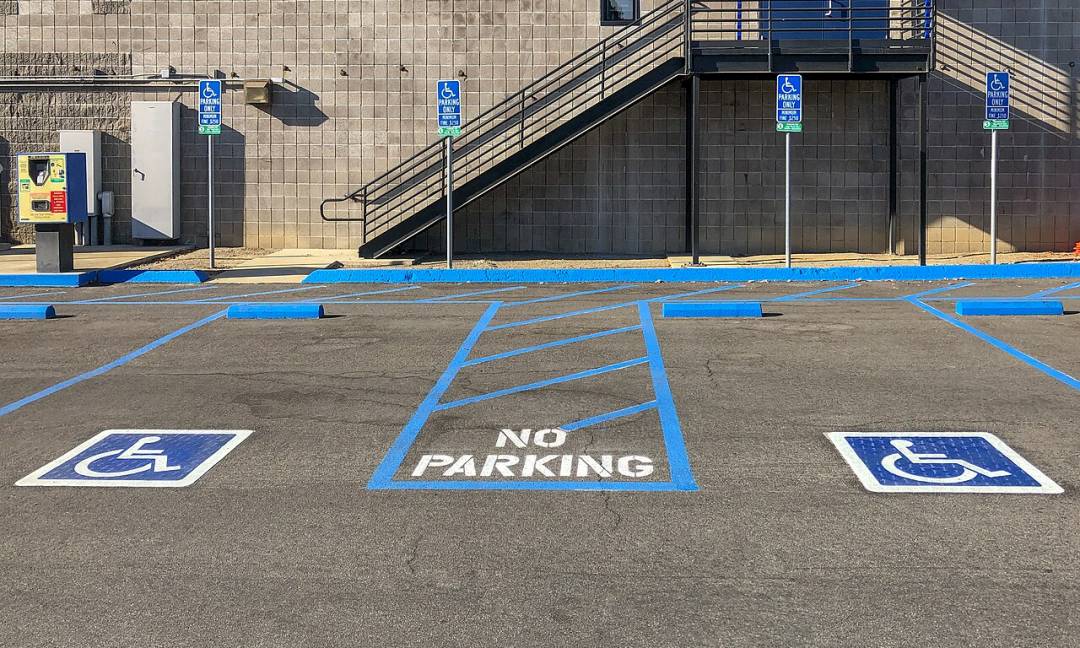
Pro Tip: Before any restripe project, walk every accessible space with a tape measure and a digital slope meter. Treat the restripe as a compliance opportunity, fixing dimensions and slopes alongside paint costs far less than returning to do a second round of work after an audit or complaint.
Signage: The Easiest Violation to Overlook and the Easiest to Fix
What the Standards Require
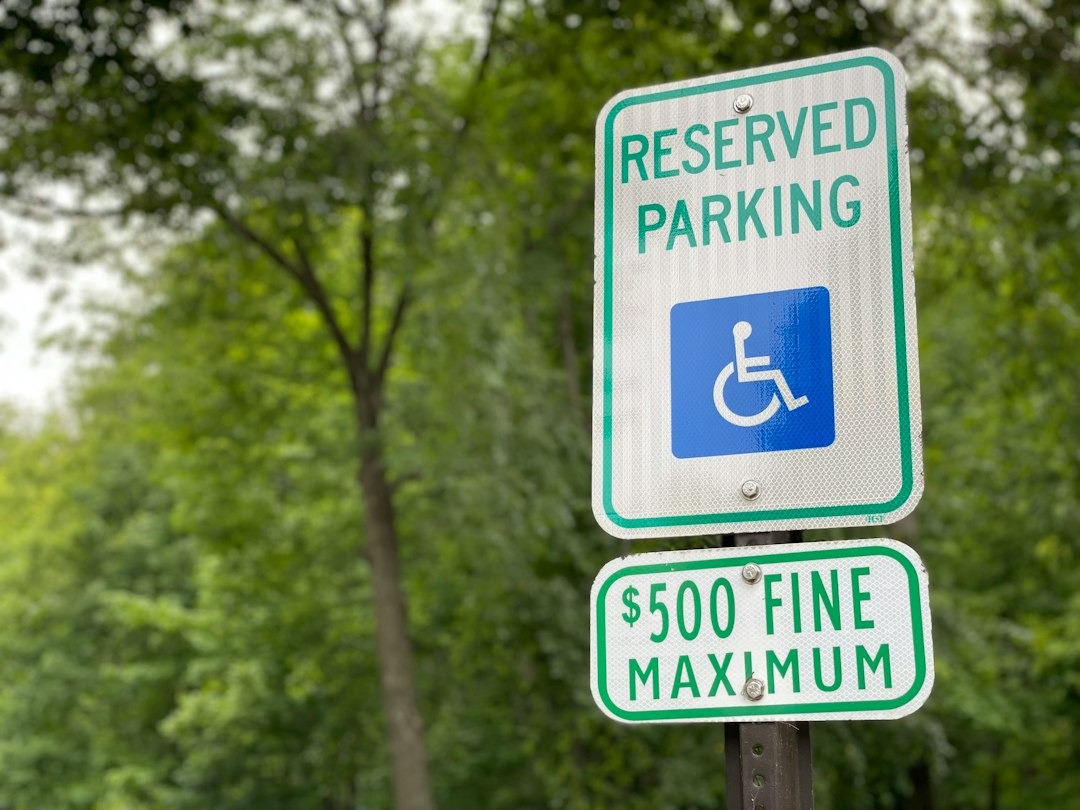
ADA signage is one of the most frequently cited violations and often one of the easiest to overlook. The ADA Standards for Accessible Design require that accessible parking signs display the International Symbol of Accessibility and be mounted so that the bottom of the sign is at least 60 inches above the ground. Signs that are mounted too low, or absent entirely, immediately put a property out of compliance.
Van-accessible spaces carry an additional requirement. They must include a secondary “Van Accessible” sign beneath the standard accessibility symbol. Without it, drivers of modified vans may be unable to identify the appropriate space. This detail is often missed after remediation, particularly when contractors replace signage and install the post-mounted sign without the secondary designation.
How Signs Fall Back Out of Compliance
Over time, signs may fade or become damaged, making them harder to notice. Physical damage from vehicles, landscaping equipment, snow clearing operations, and wind loading can shift sign heights or tilt posts out of plumb, bringing a previously compliant sign below the 60-inch threshold. Regular inspection schedules for accessible parking signage ensure continued compliance and visibility while identifying maintenance needs before signs become ineffective or non-compliant. Monthly visual inspections can identify damage, fading, or obstruction issues that affect sign effectiveness, while annual professional assessments evaluate structural integrity and compliance with current standards.
Landscaping is often the most overlooked sign obstruction. Shrubs planted near sign posts at installation height can grow to partially block the sign face within a single season. Walk the lot from a seated driver's perspective to confirm each sign remains unobstructed.
Accessible Routes and Curb Ramps: When Repair Work Creates New Barriers
How Maintenance Disrupts Accessible Routes
The accessible route connecting a parking space to the building entrance is a compliance element that often gets overlooked during remediation and then degraded by subsequent routine maintenance. The ADA Standards require that accessible routes be stable, firm, and slip-resistant, so poor pavement conditions should be repaired to maintain accessibility.
A curb with no ramp, a gravel path, or a route that forces wheelchair users through a drive lane are all violations. Patch repairs that raise or lower the surface level at transitions can create lips or abrupt edges that exceed ADA tolerances. Wherever a pedestrian route transitions to a vehicular area, truncated dome panels are required. These tactile warning surfaces alert people with visual impairments that they are entering a vehicle zone. They are required at curb ramps, at flush transitions between sidewalks and parking areas, and at transit platform edges.
The Curb Ramp Problem After Resurfacing
Overlay paving, adding a thin layer of asphalt over an existing surface, is one of the most frequent sources of recurring curb ramp violations. When a new asphalt layer is applied, the finished surface height rises. If the curb ramp was built to meet the previous surface level, the new overlay creates a vertical lip at the base of the ramp that exceeds ADA tolerances. A wheelchair user once filed an ADA complaint about a parking lot where the accessible space slopes were off-spec, and the van-accessible aisle had a 3-inch lip where the asphalt had settled. A maintenance team patched that lot twice in the past year but couldn't prove the slopes met grade after the repairs. The resulting complaint cost the property manager $8,200 in legal fees and remediation before it ever reached a courtroom.
Pro Tip: Any time asphalt overlay or patching work is performed within 20 feet of a curb ramp, inspect the ramp transition after the work cures. The cost of a one-hour inspection is orders of magnitude smaller than the cost of a single remediation project.
Building a Maintenance Program That Prevents Recurrence
Inspection Frequency and Triggers
Best practice is a full facility audit annually, plus a targeted inspection any time a covered area is altered, repaired, or repurposed. Inspect high-traffic areas such as restrooms, entrances, and parking quarterly. For properties in states with elevated enforcement activity, California, Florida, Texas, New York, and Arizona, more frequent reviews are advisable.
Specific events should trigger an immediate accessibility check: any paving, patching, sealcoating, restriping, landscaping near sign posts, snow removal operations that could shift sign posts, and any change to the total number of parking spaces on the lot. Trigger an interim audit any time stall configuration changes, EV charging is added, restriping happens, or any structural change touches the parking lot.
Documentation as Legal Protection
Commercial landlords should implement routine maintenance protocols for all exterior paths of travel. Maintaining logbooks of pavement repairs, regular re-striping schedules, continuous sign inspections, and immediate remediation of asphalt settling demonstrates due diligence. Documentation does not prevent violations, but it often decides whether a complaint escalates into litigation and, if it does, whether a property owner can demonstrate good-faith efforts.
Tools like BlueDAG’s compliance management platform are built specifically for the kind of systematic documentation that turns annual snapshots into ongoing compliance records. Tracking inspection findings, remediation timelines, and post-repair verification in one place gives you an audit trail that holds up under scrutiny.
Common Mistakes That Let Violations Come Back
- Assuming a passed audit means the lot is compliant indefinitely
- Hiring a striping-only contractor for restripe work without also verifying slopes and dimensions
- Failing to measure grades after any paving or patching work in or near accessible spaces
- Replacing signage without checking the post height against the finished pavement surface
- Neglecting to recalculate the required number of accessible and van-accessible spaces after any change to the total lot count
- Treating accessible routes as part of the general pavement maintenance cycle without checking ADA-specific surface and slope requirements at transitions
- Not documenting inspection results, leaving no evidence of good faith compliance efforts
Frequently Asked Questions
How long after remediation can ADA parking violations recur?
Parking lots should be restriped every 18 to 36 months depending on traffic levels and weather exposure. Slope violations can emerge sooner, particularly in climates with freeze-thaw cycles or clay-heavy soils that shift seasonally. In short, violations can recur within months of remediation if environmental conditions are aggressive or if a maintenance activity inadvertently introduces a new non-compliance.
Does restriping a parking lot trigger a full ADA compliance review?
Yes. When a business or state or local government restripes parking spaces in a parking lot or parking structure, it must provide accessible parking spaces as required by the 2010 ADA Standards for Accessible Design. The U.S. Department of Justice's ADA Compliance Brief on restriping makes clear that restriping is treated as an alteration, meaning the entire lot must meet current standards, not just the repainted spaces.
What are the most common ADA parking violations found after a previous remediation?
The most common ADA violations are not faded paint; they are improper slopes, incorrect dimensions, and missing or improperly placed signage. Slope drift after asphalt settles, signage damaged or shifted below the 60-inch minimum height, and curb ramp lips created by overlay paving are the violations most likely to reappear after an initial remediation.
How often should accessible parking spaces be inspected?
Audit at a minimum annually, and any time the lot is repaved, restriped, or modified. A more frequent walk-through, quarterly, for example, catches faded markings, damaged signs, and surface deterioration before they become compliance issues. Properties in high-litigation states should consider monthly visual inspections for signage and markings.
What documentation should property owners maintain for ADA parking compliance?
Plaintiffs' attorneys have found that parking slopes, signage height, and accessible route conditions are easy to photograph, easy to measure, and brutally expensive for property owners to defend without documentation. At a minimum, document every inspection date and finding, every remediation project with before-and-after measurements, and every post-repair verification check. Photographs with timestamps, slope measurements with the instrument used, and signed contractor sign-off forms all strengthen a compliance record.
Disclaimer: This article is provided for general informational and educational purposes only and is not intended to constitute legal advice or a legal opinion. While reasonable efforts have been made to provide accurate and current information, laws, regulations, standards, guidance, and interpretations may change, and no representation or warranty is made regarding the accuracy, completeness, or applicability of the information provided. References to tools, resources, or compliance approaches are for informational purposes only and do not guarantee compliance with the Americans with Disabilities Act (ADA) or any other applicable law or regulation. Readers should consult qualified legal counsel or other appropriate professionals regarding their specific circumstances. BlueDAG assumes no liability for any errors or omissions or for actions taken or not taken in reliance on the information contained in this article.
Sources
- ADA Compliance Brief: Restriping Parking Spaces, U.S. Department of Justice. Official federal guidance on restriping obligations under the 2010 ADA Standards. https://www.ada.gov/resources/restriping-parking-spaces/
- Chapter 5: Parking Spaces, U.S. Access Board. Technical requirements for accessible parking under the 2010 ADA Standards for Accessible Design. https://www.access-board.gov/ada/guides/chapter-5-parking/
- ADA Parking Striping: 2026 Requirements and Compliance Guide, Wright Construction Company. Detailed guide covering striping requirements, slope standards, and violation types. https://wrightconstructioninc.com/post/ada-parking-striping-requirements-compliance-guide/
- ADA Parking Lot Compliance Guide, Carolina Asphalt. Overview of how repairs, resurfacing, restriping, and settling introduce compliance issues over time. https://carolinaasphalt.com/ada-parking-lot-compliance-guide/
- ADA Parking Slope Limits: Why 2% Matters, COJO Asphalt. Analysis of how settling, ground movement, and freeze-thaw cycles cause slopes to drift out of compliance. https://www.cojoasphalt.com/blog/ada-parking-surface-slope-requirements
- ADA Parking Issues After Resurfacing Work, Michigan Sealcoating. Explanation of how resurfacing raises surface height and can affect grade compliance. https://thepavementgroup.com/updating-older-hoa-parking-lots-to-meet-current-ada-standards/
- ADA Parking Lot Requirements: The 2026 Compliance Guide, Anderson Striping and Construction. Comprehensive checklist of violations, penalty exposure, and maintenance requirements. https://andersonstriping.com/ada-parking-lot-requirements-the-2026-compliance-guide/
- ADA Maintenance Compliance: Documentation Checklist for Property Managers, Revoscape. First-person account of complaint costs and documentation requirements. https://revoscape.com/blog/ada-maintenance-compliance-documentation-checklist
- ADA Parking Signs: A Complete Guide to Compliance, ADAsigns. Requirements for signage height, maintenance schedules, and inspection frequency. https://www.adasigns.org/blogs/news/ada-parking-signs-compliance
- ADA Violation Rules and California Penalties, ADA Paving. California-specific guidance on asphalt settlement, slope violations, and due diligence protocols. https://www.adapaving.org/ada-violation/
- Drive-By Lawsuits: Don't Leave Your Business Vulnerable, RLB. Analysis of why parking lots are targeted in drive-by ADA litigation. https://www.rlb.com/americas/insight/dont-leave-your-office-or-business-vulnerable-to-drive-by-lawsuits/
- ADA Parking Requirements: Dimensions, Signs, Slope, Wright Construction Company. Penalty structure and recurring violation types. https://wrightconstructioninc.com/post/ada-parking-requirements-dimensions-signs-slope/
- ADA Accessibility Compliance Audit Checklist, OxMaint. Inspection frequency guidance and ongoing compliance obligations. https://oxmaint.com/industries/facility-management/ada-accessibility-compliance-checklist-building-facilities
- Parking Lot Restriping Guide, Parking Professional. ADA reconfiguration triggers and compliance obligations during restriping projects. https://parkingprofessional.com/design/parking-lot-restriping-guide/
- ADA-Compliant Parking Structures: Design and Best Practices, VPSLP. Documentation requirements and post-repair inspection protocols. https://www.vpslp.com/blog/ada-compliant-parking-structures-design-and-best-practices/