ADA Transition Plan Requirements Every Public Entity Must Meet
More than 1 in 4 adults in the United States, over 70 million people, reported having a disability in 2022, according to CDC data. Every single one of those individuals has the legal right to access public programs, services, and facilities without barriers. For state and local governments, that obligation flows directly through Title II of the Americans with Disabilities Act, and the ADA transition plan is the formal mechanism for fulfilling it.

If your agency lacks a current, well-documented transition plan, it is out of compliance with federal law, and the consequences range from DOJ investigations to costly litigation. This guide explains exactly what a transition plan is, who must have one, what it must contain, and how to keep it current as requirements evolve.
Key Takeaways
- All public entities must self-evaluate, but the transition plan is required only for agencies with 50 or more employees: Public entities with 50 or more employees must develop a transition plan that details any structural changes needed to achieve program access and specifies a completion time frame. Start the process now if your agency has not.
- The four core elements of a compliant transition plan are legally defined: The DOJ’s ADA Title II regulations at 28 CFR 35.150(d) set forth minimum transition plan requirements: identification of the official responsible for implementation; an inventory of barriers; a prioritized schedule of when barriers will be eliminated; and a description of the methods that will be used to make facilities accessible. Missing any one of these elements puts your plan out of compliance.
- Digital accessibility is now a written legal obligation, not an option: The DOJ published a final rule in April 2024 under Title II establishing that web content and mobile apps must conform to WCAG 2.1 Level AA. Your transition plan must now address digital barriers alongside physical ones.
- Plans must be updated regularly to stay valid: The transition plan should be updated periodically in order to reflect changes in the entity’s programs, activities, or facilities. A plan written in 1992 and never touched again is a liability, not a compliance document.
- Lawsuit volume is rising: Seyfarth Shaw reported 3,117 federal website accessibility lawsuits in 2025, a 27% increase over the 2,452 filed in 2024. If your plan is outdated or absent, your agency is an easy target. Treat transition planning as ongoing risk management.
Quick-Start Prioritization Framework
Strategy | Best For | Effort Level | Time to Results |
|---|---|---|---|
Appoint ADA Coordinator + start self-evaluation | Any size agency with no existing plan | Low | 1-4 weeks |
Conduct facility barrier inventory (physical) | Agencies with older buildings or no prior assessment | Medium | 1-3 months |
Add digital accessibility audit to existing plan | Agencies with an outdated plan missing web components | Medium | 2-6 weeks |
Commission third-party comprehensive plan | Agencies with complex or multi-site portfolios | High | 3-6 months |
Implement plan management software | Agencies needing living-document tracking and defensible records | Medium | Days to onboard |
Start here if you’re:
- A small agency with no plan on file: Appoint an ADA Coordinator first, then conduct a self-evaluation covering programs, services, and facilities. This is the legally mandated first step.
- A mid-size government with an outdated plan: Update the barrier inventory, add a digital accessibility section addressing WCAG 2.1 Level AA, and revise your remediation schedule.
- A large or multi-site public entity: Commission a third-party facility assessment alongside a digital audit, and use purpose-built software to manage the living document across departments.
What Is an ADA Transition Plan, and Who Must Have One?
An ADA transition plan is a formal, written document that describes how a public entity will remove physical and programmatic barriers that prevent people with disabilities from accessing its programs, services, and activities. The Americans with Disabilities Act requires each public entity to conduct and maintain an ADA Transition Plan. The plan identifies where a facility, program, service, or practice may be deficient under current ADA standards, ranks the deficiency by overall importance, provides a rough cost estimate to bring the item into compliance, and creates a schedule to complete the required repairs.
The ADA requires state and local governments to ensure their programs, activities, and services are available to people living with disabilities, including by developing an ADA Transition Plan. Title II of the ADA provides the legal basis, applies specifically to government entities, and is implemented in 28 CFR §35.150.
The 50-Employee Rule
The ADA requires all state and local government agencies employing 50 or more individuals to complete an ADA Self-Evaluation and Transition Plan. This requirement extends to all public entities, regardless of size, for the self-evaluation portion, but the formal written transition plan is triggered specifically at the 50-employee threshold.
In practice, this covers an enormous range of entities: city and county governments, school districts, public universities, transit agencies, parks and recreation departments, water authorities, and any other state or local body providing public services.
The Relationship Between Self-Evaluation and Transition Plan
The transition plan is developed from the self-evaluation and facilities survey. Think of the self-evaluation as the diagnostic: it tells you what barriers exist. The transition plan is the prescription: it commits your agency to removing those barriers on a defined schedule with named responsible parties. One cannot exist without the other. The transition plan is developed from the self-evaluation and facilities survey, making the quality of your self-evaluation the foundation on which everything else rests.
Pro Tip: Even if your agency originally completed a transition plan decades ago, that does not mean you are in compliance today. It is recommended that public entities periodically reassess their facilities to determine if the original transition plan was followed, if the entity complies with the updated standards, and whether additional access improvements are needed.
The Four Legally Required Elements of a Transition Plan
The DOJ’s ADA Title II regulations include guidance that directly maps the minimum transition plan components to the regulations. 28 CFR 35.150(d) requires four elements: identifying the official responsible for implementation; an inventory of barriers identifying physical obstacles; a prioritized schedule for eliminating barriers; and a description of the methods used to make facilities accessible. Here is what each element demands in practice.
1. A Named Responsible Official (ADA Coordinator)
Public entities that have 50 or more employees are required to have a grievance procedure and to designate at least one responsible employee to coordinate ADA compliance. Although the law does not require the term “ADA Coordinator," state and local governments across the country commonly use it. The ADA Coordinator’s role is to coordinate the government entity’s efforts to comply with the ADA and investigate any complaints that the entity has violated the ADA.
Naming this person in your transition plan document, with current contact information visible to the public, is a minimum requirement, not a courtesy. Many agencies overlook this step or list someone who has since left the organization, which immediately signals a lapsed plan to any federal investigator.
2. An Inventory of Barriers
Agencies must survey facilities and determine whether physical barriers prevent access to programs. If non-structural changes are needed, include them in the action plan. If structural changes are needed, include them in the transition plan. The inventory must also cover programmatic and policy barriers, not just physical ones.
The self-evaluation and transition plan require collecting information from all programs, services, and activities of the entity, a task too large for one person. The transition plan and self-evaluation require varied expertise and specialized skills. Therefore, assemble a cross-departmental team with representation from facilities, IT, HR, and direct service departments.
3. A Prioritized Remediation Schedule
Your plan must identify what barriers exist, prioritize what matters most, and document your approach for addressing accessibility barriers over time. The plan should include timelines, responsible parties, and methods for tracking progress.
Prioritization is not arbitrary. A transition plan must also include a schedule for providing curb ramps, prioritizing walkways serving entities covered by the ADA, including state and local government offices and facilities, transportation, places of public accommodation, and employers, followed by walkways serving other areas. Failure to follow the legally prescribed priority order can itself constitute a compliance deficiency.
4. Methods for Barrier Removal
The plan must explain how your agency will actually fix identified barriers, not just that it will do so. Developing a Transition Plan for needed structural changes enables agencies to identify physical obstacles in facilities that limit accessibility of their programs and activities to individuals with disabilities and specify steps and a schedule to achieve Title II compliance.

Pro Tip: Many public entities include cost estimates and which budget the funds will come from as part of their plan. While not legally mandated, adding cost estimates and funding sources turns your transition plan into a capital planning tool and strengthens your defense in the event of a complaint or lawsuit.
The Digital Accessibility Requirement You Cannot Ignore
The scope of a compliant transition plan has expanded significantly since the early 1990s. The DOJ published a final rule in April 2024 under Title II establishing that web content and mobile apps must conform to WCAG 2.1 Level AA, a concrete technical benchmark replacing years of enforcement ambiguity. Web and digital accessibility for public entities is now a defined legal obligation.
Current Compliance Deadlines
The DOJ extended the original compliance dates in April 2026. Large entities now must comply by April 26, 2027, and smaller entities and special districts by April 26, 2028. The substantive requirements of the 2024 rule remain unchanged. The extension of time does not reduce the obligation; it simply shifts the due date by one year.
The deadlines moved; the rule itself did not. The fact that DOJ extended the timeline rather than reopening the substance tells you that accessible state and local government digital services remain a federal priority.
What the Digital Requirement Means for Your Transition Plan
Your transition plan must now include a digital inventory alongside your physical one. The rule requires a “transition plan” for bringing existing digital assets into compliance. This does not mean you have to fix everything immediately. It means you need to identify what you have, prioritize what matters most, and document your approach for addressing accessibility barriers over time.
In practical terms: document your website, online forms, payment portals, mobile apps, and any third-party digital services you make available to the public. A thorough government website accessibility audit and the changes that follow take significant effort. Procrastination is not a viable strategy for meeting these requirements.
Pro Tip: Many agencies relied on static PDFs to publish public materials. Most PDFs are not automatically accessible, and complex financial tables often fail screen readers without extensive tagging and remediation. Even when remediated once, each annual update requires additional accessibility work. Plan for recurring digital remediation, not a one-time fix.
How to Keep Your Transition Plan Current
One of the most common compliance failures among government entities is the “set it and forget it” approach to transition planning. A plan written in 1992 and left untouched is not compliant; it is a liability.
Treat It as a Living Document
The Transition Plan is intended to be a living document, updated regularly to inform both staff and people with disabilities. The plan should be updated periodically to ensure the ongoing needs of the community continue to be met, and changes to the plan shall be made available to the public for comment.
Some agencies formalize this with a five-year update cycle. The plan will be updated every five years to track progress, refine how priorities are set, and update program costs, and each update will include a public comment period.
Why So Many Plans Are Outdated
Because changes were made to the Title II regulations and the ADA Standards for Accessible Design in 2010, an updated self-evaluation is strongly recommended. The Title II regulations and ADA Standards were updated to include recreation areas (from play areas to swimming pools), residential facilities, event ticketing policies, and specifications for video-remote interpreting. Agencies that completed a plan before 2010 and never revised it are almost certainly missing these categories entirely.
Many institutions have cited cost, lack of awareness, and resistance to change as reasons they have not fully complied. These pressures are understandable, but they do not constitute legal defenses.
Using Software to Manage the Process
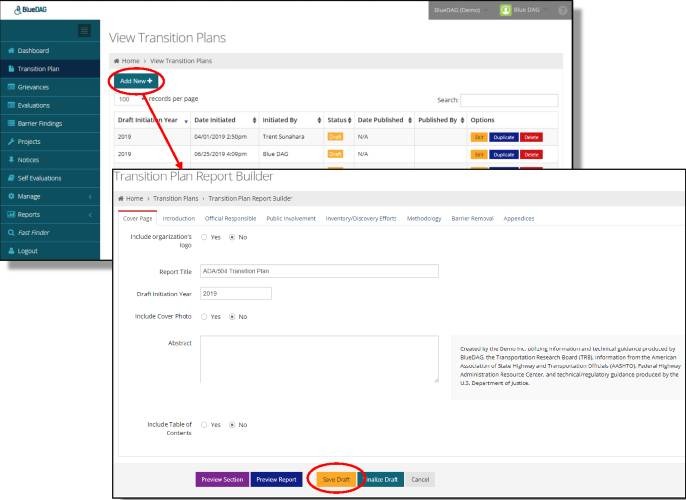
Managing a transition plan across multiple departments, facilities, and budget cycles with spreadsheets and PDFs creates exactly the kind of data gaps that make agencies vulnerable. Purpose-built tools change this equation. BlueDAG helps public agencies keep ADA work organized, inspections, transition plans, grievances, staff training, and ongoing support in one system. BlueDAG is the complete ADA compliance platform for government agencies. Platforms like BlueDAG connect barrier tracking, remediation scheduling, and grievance management into a single defensible record, which matters if you ever face a DOJ inquiry or private lawsuit.
 immediately expose that gap
Common Mistakes That Leave Agencies Exposed
Even agencies that have a transition plan on file often have gaps that a complaint or investigation would surface. In my experience reviewing compliance documentation, the same errors appear repeatedly.
Missing or Outdated ADA Coordinator Designation
The plan names a coordinator who retired three years ago. Contact information is wrong or absent. This is a visible signal that the plan has not been maintained and immediately undermines any good-faith compliance argument.
No Digital Accessibility Section
Digital accessibility considerations barely existed when the ADA was passed in 1990. Now all state and local governments have websites that must be accessible to people with disabilities, so websites need to be evaluated. Plans that address only physical facilities while ignoring web content, apps, and online forms are materially incomplete under the 2024 DOJ rule.
Barrier Inventory That Has Never Been Updated
Many public entities are reassessing their facilities to determine whether they followed the original transition plan and whether they need additional access improvements. If your inventory dates from 1993 and your agency has added facilities, programs, or services since then, your plan no longer reflects reality, and a complaint about any of those newer areas would immediately expose that gap.
No Public Comment Process
Public entities must provide an opportunity for interested individuals to participate in the self-evaluation and transition planning processes by submitting comments. Skipping this step is not just a procedural oversight; it cuts off the feedback from people with disabilities who often identify barriers that internal staff overlook.
Pro Tip: California-based public entities should also be aware of the CASp (Certified Access Specialist) program. Certified Access Specialists are experts in ADA and California Building Code compliance. CASp Inspectors are rigorously tested by the Division of the State Architect to demonstrate specialized knowledge of disability access requirements in the State of California. Engaging a CASp for your facility assessments adds a layer of professional credibility to your transition plan documentation.
Frequently Asked Questions
What exactly is an ADA transition plan and why does my agency need one?
Developing a transition plan is required under the ADA. If the entity does not have and maintain a current ADA transition plan, it will be out of compliance with federal law. The plan documents your agency’s commitment to removing barriers and gives the public, the DOJ, and the courts a written record of your good-faith compliance effort.
How often does a transition plan need to be updated?
Update ADA Transition Plans periodically until you eliminate the inventory of all accessibility barriers. There is no fixed statutory interval, but any significant change in your facilities, programs, services, or the applicable standards (such as the 2024 digital accessibility rule) triggers a need for review. Many agencies adopt a three-to-five-year update cycle with interim updates when material changes occur.
Does the transition plan need to cover our website and digital content?
Yes. The DOJ has set a binding standard requiring state and local government websites and mobile apps to conform with WCAG 2.1 Level AA. This marks the first codified digital accessibility regulation in ADA history. Large entities must comply by April 26, 2027, and smaller entities and special districts by April 26, 2028. The substantive requirements of the 2024 rule remain unchanged. Your transition plan must include a digital inventory and remediation schedule to address these obligations.
What are the consequences of not having a compliant transition plan?
Federal agencies, most notably the DOJ, enforce the ADA and may impose civil penalties for noncompliance. These penalties apply to willful or repeated violations of accessibility requirements in places of public accommodation, employment facilities, and state or local government programs. Beyond civil penalties, in most private ADA cases, prevailing plaintiffs can recover reasonable attorney’s fees and costs, creating a financial incentive for advocates and individuals to pursue enforcement when access barriers persist.
How much does it typically cost to develop an ADA transition plan?
Costs vary widely by agency size and scope. Cabarrus County staff presented ADA transition plan requirements and two vendor options, with cost estimates ranging from roughly $14,000 for a phased approach up to $94,575 for a comprehensive third-party contract. Larger jurisdictions with extensive facilities will face proportionally higher costs. However, spreading assessments across budget cycles and using software to manage the resulting data significantly reduces total cost compared to a single all-at-once engagement.
Start Now, Not Later
The ADA transition plan is one of the clearest and most enforceable compliance obligations facing public entities. The legal framework is settled, the required elements are published in federal regulations, and the enforcement environment is active. Since 2011, 142 municipalities in the U.S. have been sued for accessibility noncompliance, and that number keeps growing as digital accessibility litigation accelerates.
The good news is that a good-faith, well-documented transition plan, one that is current, publicly available, and actively maintained, is your strongest protection. Agencies that treat their transition plan as a living operational tool rather than a filing-cabinet artifact are the ones best positioned to demonstrate compliance when it matters.
If your agency needs to build, update, or manage its ADA transition plan, BlueDAG provides purpose-built software and expert support to keep your compliance work organized, defensible, and current.
Disclaimer: This article is provided for general informational and educational purposes only and is not intended to constitute legal advice or a legal opinion. While reasonable efforts have been made to provide accurate and current information, laws, regulations, standards, guidance, and interpretations may change, and no representation or warranty is made regarding the accuracy, completeness, or applicability of the information provided. References to tools, resources, or compliance approaches are for informational purposes only and do not guarantee compliance with the Americans with Disabilities Act (ADA) or any other applicable law or regulation. Readers should consult qualified legal counsel or other appropriate professionals regarding their specific circumstances. BlueDAG assumes no liability for any errors or omissions or for actions taken or not taken in reliance on the information contained in this article.
Sources
- ADA Update: A Primer for State and Local Governments, U.S. Department of Justice. Official guidance on Title II requirements for public entities. https://www.ada.gov/resources/title-ii-primer/
- ADA Transition Plans Memoranda, Federal Highway Administration. Minimum required attributes for compliant transition plans under 28 CFR 35.150(d). https://www.ecfr.gov/current/title-28/chapter-I/part-35/subpart-D/section-35.150
- ADA Self-Evaluation and Transition Plans (Action Guide), ADA Action Guide. Practical guidance on transition plan content and process. https://adaactionguide.org/action-steps
- CDC Data Shows Over 70 Million U.S. Adults Reported Having a Disability, Centers for Disease Control and Prevention. July 2024 disability prevalence data. https://www.cdc.gov/media/releases/2024/s0716-Adult-disability.html
- DOJ Extends Public Entities’ Compliance Deadline for ADA-Related Website Accessibility, Jackson Lewis. Analysis of the April 2026 Interim Final Rule extending digital accessibility deadlines. https://www.jacksonlewis.com/insights/doj-extends-public-entities-compliance-deadline-ada-related-website-accessibility-hhss-may-2026-deadline-still-looms
- ADA Title II Deadline Extended: What This Means for Public Entities, 3Play Media. Analysis of the 2027 and 2028 digital compliance deadlines. https://www.3playmedia.com/blog/title-ii-deadline-extended/
- Consequences of Accessibility Non-Compliance, Delaware Government Information Center. ADA civil penalties and municipal enforcement data. https://gic.delaware.gov/consequences-of-accessibility-non-compliance/
- ADA Title II: State and Local Government Accessibility Requirements, National Disability Authority. Overview of Title II obligations, including grievance procedures and transition plans. https://nationaldisabilityauthority.com/ada-title-ii-state-and-local-government
- 7 ADA Grievance Tracking Tools To Keep Your Agency on Track, BlueDAG. Data on ADA lawsuit trends and purpose-built compliance software. https://www.bluedag.com/7-ada-grievance-tracking-tools-to-keep-your-agency-on-track.html
- BlueDAG: The Complete ADA Compliance Platform, BlueDAG. ADA transition plan management software for public agencies. https://www.bluedag.com/
- ADA Transition Plan Requirements for Local Agencies, Colorado Department of Transportation. State-level guidance on transition plan update requirements. https://www.codot.gov/business/civilrights/ada/transition-plans-la
- CASp Certification, California Division of the State Architect. Official information on the Certified Access Specialist program. https://www.dgs.ca.gov/DSA/Certifications/Page-Content/Certified-Access-Specialist-CASp-Certification
- DOJ’s ADA Title II Rule: What You Actually Need to Do, Accessiblü Solutions. Practical breakdown of transition plan obligations under the 2024 digital rule. https://www.accessiblu.com/insights/dojs-ada-title-ii-rule-what-you-actually-need-to-do-by-april-2026/
- How to Develop an ADA Transition Plan, Kimley-Horn. Practitioner guidance on living-document transition plan management. https://www.kimley-horn.com/news-insights/perspectives/how-to-develop-ada-transition-plan/