ADA Audits Are Just the First Step Toward Compliance
Getting an ADA audit feels like a meaningful accomplishment, and it is. You hired a professional, walked the facility, documented the barriers, and received a written report. But here is what that report cannot do on its own: make you compliant. ADA compliance is an ongoing maintenance obligation that requires systematic inspection, documentation, and corrective action across your entire facility, not a box to check when the consultant leaves.
About 28.7 percent of U.S. adults live with some form of disability according to CDC data, and these individuals depend on physical spaces that work for them. The gap between completing a physical accessibility audit and achieving genuine, sustained compliance is where most organizations lose ground. This article explains what an audit does and does not accomplish, and what you need to do next.

Key Takeaways
- An audit identifies barriers; remediation removes them: An audit identifies accessibility issues and defines a remediation path, but compliance isn’t a one-time state; it depends on implementation and maintenance. Schedule your first remediation priorities within 30 days of receiving your report.
- Physical barriers remain widespread: Despite the ADA having been in effect for more than three decades, physical accessibility gaps persist. One survey found that 60.4% of respondents with mobility disabilities had experienced serious difficulty or were completely unable to enter a public building because of missing wheelchair ramps, automatic doors, or elevators. If that statistic applies to your facility, your audit findings demand urgent action.
- A transition plan bridges findings and action: Public entities that employ at least 50 persons must have an ADA Transition Plan, which sets out the steps needed to complete modifications identified through self-evaluation and provides a schedule for completing them. Without a written schedule, a list of barriers is just a list.
- Re-evaluation must happen on a schedule: Determining what changes are readily achievable is a recurring effort. Re-evaluate access annually, because barrier removal that may be difficult now may be readily achievable later.
- Staff training closes gaps that physical fixes cannot: ADA training equips staff with the knowledge and skills needed to accommodate individuals with disabilities appropriately and helps prevent discrimination so that services, facilities, and employment practices are accessible to all.
Quick-Start Prioritization Framework
Use this table to decide where to focus your energy first after an audit is complete.
Step | What It Involves | Effort Level | Time to Results |
|---|---|---|---|
Prioritize critical barriers | Fix entrances, ramps, and restrooms first | Low to medium | Days to weeks |
Build a transition plan | Document timelines, costs, and responsible parties | Medium | 2 to 6 weeks |
Remediate structural barriers | Hire contractors for architectural modifications | High | Weeks to months |
Train staff | Educate all public-facing employees | Low | Ongoing |
Schedule re-audits | Annual reviews and post-renovation checks | Low | Recurring |
Start here if you are:
- A small organization or single-site facility: Focus on readily achievable barrier removal first, entrances, signage, and parking. These require the least cost and deliver the most immediate impact for visitors.
- A government or public agency: You are likely subject to a formal transition plan requirement. Title II of the ADA requires all public agencies, regardless of size, to ensure that their services, programs, and activities are accessible to persons with disabilities, including conducting a self-evaluation of building facilities and rights-of-way to identify accessibility obstacles.
- A multi-site organization: Systematically address accessibility across your portfolio. Violations at one location can trigger scrutiny of all properties, potentially multiplying liability exposure and retrofit costs. Addressing accessibility systematically across the entire portfolio may reduce that risk.
What an ADA Audit Does, and Does Not Do
The Purpose of a Physical Audit
An accessibility audit is a workplace assessment a professional conducts to evaluate worksite accessibility, including parking lots, entrances and exits, hallways, restrooms, and common areas. A thorough audit is an essential foundation. It tells you what barriers exist, where they are, and which federal standards they violate. Without this foundation, any remediation plan is guesswork.
ADA standards have improved physical accessibility, but field-audit approaches using checklists manually evaluate accessibility by providing explicit criteria for identifying barriers, remaining central to facility audits, sidewalk assessments, and campus reviews. That remains valuable and necessary.
Where Audits Fall Short
The trouble starts when organizations treat the audit report as the end point. Most ADA compliance efforts begin and end with a hired consultant producing a written audit report that documents barriers as they existed on the day of the inspection, then filing it. Six months later, staff has changed, priorities have shifted, and no one can confidently say what has been remediated, what remains outstanding, or whether the agency could defend its compliance posture in front of a federal investigator.
Field audits are labor-intensive, episodic, focused on minimum compliance rather than everyday user navigation, and not designed for end-user tools. That episodic nature is a core limitation. A physical facility changes after a renovation, a new tenant moves in, or deferred maintenance creates new barriers. An audit taken two years ago reflects a facility that may no longer exist.
Pro Tip: Ask your audit provider not just for a list of violations but for a prioritized remediation matrix that ranks each barrier by severity, user impact, and estimated cost. A ranked list converts a report into an action plan.
Building a Transition Plan from Audit Findings
What a Transition Plan Must Include
An audit report and a transition plan serve different purposes. The audit finds the problems. The transition plan establishes who fixes them, how, and by when. A transition plan must include a list of physical barriers that limit access to programs and services, methods to remove the barriers and make facilities accessible, a schedule for completing the work, and the name of the official responsible for implementing the plan.
The physical audit should end with an owner for every barrier. Assign common-area items to the district or property manager, storefront items to the tenant, and event-day controls to the organizer. Without accountable owners, a list becomes a recurring accessibility failure.
Turning Audit Findings into a Prioritized Schedule
Not every barrier can be fixed immediately, and the law recognizes that. Congress understood that making all infrastructure accessible within a short time frame would be an insurmountable financial burden for an agency. As a result, public agencies may transition to full compliance through an ADA Transition Plan that identifies physical access barriers and proposes a removal schedule based on financial capacity.
For commercial spaces, three practical areas trigger the most violations and lawsuits: entryway accessibility, circulation paths, and bathroom facilities. Use those categories to organize your remediation schedule, front-loading your highest-impact, most-visible barriers.

Pro Tip: A transition plan is a living document, not a static PDF. Update it every time a barrier is remediated, a new inspection is completed, or a renovation changes the facility layout. Agencies that can produce a current, accurate transition plan during a compliance review are far better positioned than those presenting an outdated report.
Common Physical Barriers That Appear After an Audit
Entrance and Path of Travel Violations
Physical barriers create the most immediate and obvious ADA violations, directly preventing people with disabilities from accessing goods, services, and employment opportunities. Among the most frequently cited, missing or inadequate ramps represent one of the most fundamental barriers; when entrances have steps but no ramp alternative, wheelchair users simply cannot enter.
Door hardware that requires tight grasping or twisting to operate is another common ADA violation that prevents people with disabilities from accessing spaces equally. These details are easy to overlook in a visual walk-through and are exactly why a systematic checklist matters.
Parking and Restroom Deficiencies
Before customers even reach your entrance, parking violations can trigger ADA complaints. The ADA requires one accessible space per 25 parking spots for lots with 1 to 100 spaces. Parking slopes, improper signage, and missing access aisles are among the California Commission on Disability Access's most frequently cited construction-related violations nationwide.
Restrooms often contain ADA violations because of the sheer number of features and dimensions they must meet. A single restroom can have dozens of accessibility barriers that may not be easy for a layman to spot. This is where a certified inspector adds significant value over a checklist-only approach.
Barriers That Develop Over Time
One pattern I have seen repeatedly is that facilities pass an audit and then gradually drift out of compliance through routine facility changes. A new service counter installed at the wrong height, a repaired ramp that now exceeds the allowable slope, or a relocated sign that no longer meets placement standards- these are not the result of bad intentions. They result from the absence of a maintained compliance program.
The ADA has no grandfather clause. Existing buildings must remove accessibility barriers where readily achievable, and the building's age does not exempt it from this ongoing obligation. The readily-achievable standard is reassessed each time the facility undergoes alteration or maintenance work.
The Role of Staff Training in Physical Accessibility
Why Training Is a Compliance Requirement, Not an Option
Physical modifications address the built environment. Staff training addresses how people experience it. An accessible restroom matters little if a visitor cannot get directions to it from a staff member who is unfamiliar with accessibility features. Organizations must determine whether employees and officials understand ADA obligations, including the requirement to make reasonable modifications to policies, practices, and procedures.
ADA training teaches people to recognize barriers, respond to accommodation requests, communicate respectfully, and design policies and facilities that more people can use. Training connects the physical modifications you have made to the human interactions that determine whether those modifications actually serve people with disabilities.
Building a Culture of Ongoing Awareness
Ensuring ongoing compliance requires regular monitoring and improvement. Employers should conduct routine audits of workplace policies, procedures, and facilities to identify areas needing improvement. Training is most effective when it is treated as a recurring investment, not a one-time onboarding task.
Ongoing training keeps employees and management up to date on the latest ADA requirements and best practices, and appointing a designated ADA compliance officer provides someone to oversee compliance and address concerns as they arise.
Pro Tip: Schedule brief, focused refreshers for staff whenever a physical modification is completed. Staff who understand why a new ramp, counter, or restroom feature was installed are far more likely to direct visitors to it appropriately and to flag if it becomes obstructed or damaged.
Maintaining Compliance Over Time
Annual Reviews and Post-Renovation Checks
Conduct regular accessibility audits at least annually, with additional testing whenever you make significant changes to physical facilities. An annual review does not need to be a full inspection every time. A structured walkthrough against your existing findings, checking that remediated barriers remain fixed, that no new barriers have been introduced, and that priorities for unremediated items are still accurate, provides meaningful compliance continuity.
Facilities that implement comprehensive monitoring across accessibility requirements build defensible compliance programs that demonstrate ongoing attention to ADA obligations. That documented attention is valuable if your facility is ever subject to a complaint investigation.
Technology and Program Management
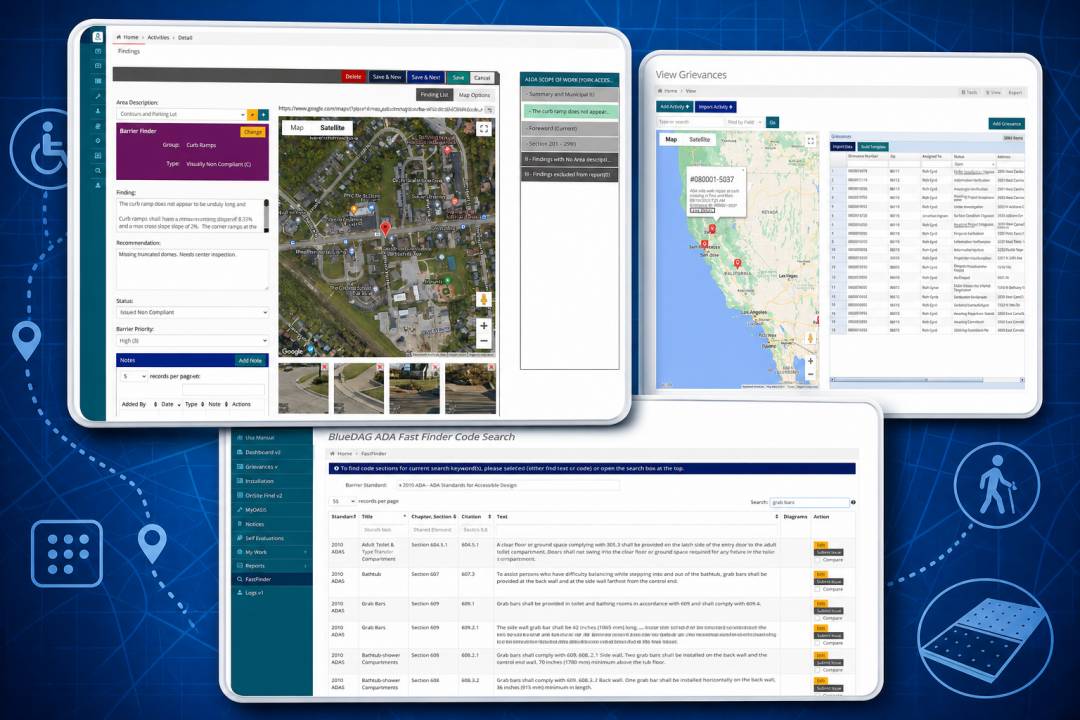
Managing ADA compliance across a portfolio of facilities, multiple inspectors, and multi-year remediation timelines is a coordination challenge that spreadsheets and PDF reports do not solve well. BlueDAG's cloud-based software suite helps agencies manage ADA work from evaluation through remediation, with plans paired with client success support so teams can use the system in day-to-day operations.
The BlueDAG platform gives agencies a centralized, map-based system to manage every aspect of their ADA compliance program. Barrier data collected in the field flows directly into the dashboard, the Living Transition Plan updates automatically, and reports are always current. For organizations managing complex compliance programs, www.bluedag.com offers a structured approach that keeps an audit’s findings connected to real-world remediation progress over time.
Pro Tip: In my experience, the organizations that maintain the strongest compliance posture are those that treat their transition plan as a living document with regular review cycles, not as a project with a finish line. Compliance obligations continue every day after an audit is completed.
Frequently Asked Questions
Does completing an ADA audit mean my facility is compliant?
No. An audit identifies accessibility issues and defines a remediation path, but compliance is not a one-time state and cannot be guaranteed. Compliance requires removing identified barriers, following a remediation schedule, and maintaining the facility to those standards over time.
What is the difference between readily achievable barrier removal and a transition plan?
Readily achievable barrier removal applies to existing facilities and covers modifications that can be accomplished without significant difficulty or expense, things like adding accessible signage, repositioning furniture, or installing door hardware. A transition plan covers more involved structural modifications. When structural or architectural modifications are required to achieve program accessibility, a public entity with fifty or more employees should develop a transition plan that includes a list of physical barriers in facilities that limit access and a detailed outline of methods for removing those barriers.
How often should I re-audit my physical facility?
Repeat the process of determining what changes are readily achievable annually. In addition, any significant renovation, change in facility use, or new construction triggers the need for an updated accessibility review. For multi-site organizations, a rolling annual audit schedule ensures that every facility is evaluated on a regular cycle.
What are the most common physical barriers found in commercial facilities?
For commercial spaces, the three practical areas that trigger the most violations and lawsuits are entryway accessibility, circulation paths, and bathroom facilities. Within those areas, common issues include non-compliant parking, inadequate ramp slopes, door hardware that requires grasping or twisting, and restroom configurations that do not meet dimensional requirements.
Can my organization face legal liability even if we completed an audit?
Yes. An audit without follow-through on remediation, a transition plan, and ongoing monitoring leaves significant legal exposure. ADA compliance is a continuous maintenance obligation, and the Department of Justice has made that point with $75,000 fines for a single first-time violation and $150,000 for repeat infractions. A documented, active compliance program is your strongest defense.
Disclaimer: This article is provided for general informational and educational purposes only and is not intended to constitute legal advice or a legal opinion. While reasonable efforts have been made to provide accurate and current information, laws, regulations, standards, guidance, and interpretations may change, and no representation or warranty is made regarding the accuracy, completeness, or applicability of the information provided. References to tools, resources, or compliance approaches are for informational purposes only and do not guarantee compliance with the Americans with Disabilities Act (ADA) or any other applicable law or regulation. Readers should consult qualified legal counsel or other appropriate professionals regarding their specific circumstances. BlueDAG assumes no liability for any errors or omissions or for actions taken or not taken in reliance on the information contained in this article.
Sources
- ADA Accessibility Compliance Checklist for Building Facilities, OxMaint. Overview of facility-level ADA compliance as an ongoing obligation. https://oxmaint.com/industries/facility-management/ada-accessibility-compliance-checklist-building-facilities
- ADA Standards for Accessible Design Guide 2026, Rimkus. Guidance on architectural barriers and multi-site liability. https://rimkus.com/article/ada-standards-accessible-design-compliance-guide/
- Disability Statistics in the U.S., AudioEye. Key data on physical accessibility gaps and mobility disability statistics. For current information on physical accessibility gaps and mobility disability statistics, refer to CDC disability statistics data.
- ADA Self-Evaluation and Transition Plans, ADA Action Guide. Federal requirements for transition plan content. https://adaactionguide.org/action-steps
- Physical Accessibility in the Workplace, Job Accommodation Network (JAN). Overview of workplace accessibility audits. https://askjan.org/articles/Physical-Accessibility-in-the-Workplace.cfm
- Common ADA Violations, Nisar Law Group. Examples of physical ADA violations including ramps, doorways, and parking. https://www.nisarlaw.com/blog/2025/september/common-ada-violations/
- Top ADA Violations, ProActive Access. Construction-related barriers, including door hardware and restrooms. https://www.proactiveaccess.com/ada-violations
- ADA Facility Compliance Maintenance for Public Buildings, OxMaint. DOJ penalty structure and the ongoing inspection obligation. https://oxmaint.com/industries/government/ada-facility-compliance-maintenance-for-public-buildings
- ADA Compliance Requirements, HRcertification. Ongoing monitoring practices for ADA compliance programs. https://hrcertification.com/ada-compliance-requirements
- Staff Training Guide for ADA Compliance, Know the ADA. Why staff training is essential and how to measure its impact. https://know-the-ada.com/staff-training-guide-for-ada-compliance/
- ADA Checklist for Existing Conference and Meeting Facilities, DC Office of Disability Rights. Annual re-evaluation guidance. https://odr.dc.gov/book/appendix-checklist
- Top Ten Alleged Construction-Related Disability Access Violations, California Commission on Disability Access (CCDA). Parking, path of travel, and restroom violation data. https://www.dgs.ca.gov/CCDA/Resources/Page-Content/California-Commission-on-Disability-Access-Resources-List-Folder/Top-Ten-Alleged-Construction-Related-Violations-for-2022
- Website Compliance Auditing, Accessibility.works. Audits identify issues but do not guarantee compliance. https://www.accessibility.works/website-ada-accessibility-compliance-audit/
- ADA Compliance: How to Meet Your Legal Obligation, Daeryun Law. Continuous legal obligation and DOJ enforcement. https://www.daeryunlaw.com/us/practices/detail/ada-compliance
- How It Works, BlueDAG. Methodology for moving from audit findings to a living compliance program. https://www.bluedag.com/how-it-works.html
- Title II Software Suite for ADA Compliance, BlueDAG. Cloud-based platform for managing evaluations, transition plans, and remediation. https://www.bluedag.com/software.html
- ADA Transition Plan Requirements, Federal Highway Administration. Minimum required attributes for transition plans under 28 CFR 35.150(d). For detailed information on required attributes for transition plans under 28 CFR 35.150(d), see FHWA ADA transition plan guidance on 28 CFR 35.150(d).
- ADA Standards for Accessible Design, U.S. Access Board. 2010 ADA Standards as the baseline for physical compliance. https://www.access-board.gov/ada/