How to Crowdsource ADA Inspections Across a Large Public Portfolio
Managing physical accessibility across a large public portfolio is one of the most demanding compliance challenges local governments face today. A single county might oversee hundreds of parks, community centers, libraries, transit stops, parking lots, and public restrooms, each one a separate facility that must be evaluated against the 2010 ADA Standards for Accessible Design published by the U.S. Access Board. Hiring outside consultants to inspect every site individually is slow and expensive. For many agencies, the answer is to crowdsource the work, distributing inspection tasks across existing staff, trained teams, and technology platforms so data flows in from dozens of sites simultaneously.
This guide explains exactly how to build that kind of distributed inspection program, from the foundational setup to quality control and reporting.

Key Takeaways
- Scale is the real barrier: 70% of U.S. municipalities lack a current ADA transition plan, and the reason is almost always the same: they don't have enough inspectors to cover an entire portfolio. Distribute the work, or it will never get done.
- Title II applies to every public entity: Title II applies to all public agencies, regardless of size, to ensure that their services, programs, and activities are accessible to persons with disabilities, including conducting a self-evaluation of building facilities and rights-of-way to identify accessibility obstacles. If you have not completed a current self-evaluation, you are already behind.
- Crowdsourcing physical inspections is proven: Crowdsourced accessibility maps help individuals with disabilities, yet few authoritative maps cover large areas comprehensively because on-site inspections are expensive; crowdsourcing offers a promising, low-cost alternative. The same logic applies to a government facility portfolio.
- Staff training is the foundation: A critical but often overlooked component of success is comprehensive, ongoing staff training. Distributed inspections fail when field staff cannot reliably identify and record barriers.
- Documentation must feed a living plan: Organize field data so it can populate a living transition plan, support budget decisions, and show progress over time. Raw findings that sit in spreadsheets do not drive remediation.
Quick-Start Prioritization Framework
Strategy | Best For | Effort Level | Time to Results |
|---|---|---|---|
Apprentice staff model | Parks, transit, facilities with many field workers | Low | Weeks |
Tandem inspection teams | Complex buildings, recreation facilities | Medium | Weeks to months |
Virtual pre-inspection review | Large portfolios with existing photos or plans | Low | Days |
Dedicated ADA coordinator + field liaisons | Agencies with 50+ employees | Medium | 1-3 months |
Platform-based distributed workflow | Statewide or multi-jurisdiction programs | High | 3-6 months |
Start here if you’re:
- A small municipality with limited staff: Deploy the apprentice model, assign trained field staff to specific facility clusters and give them standardized mobile checklists.
- A mid-size county or parks agency: Pair the tandem team approach with a centralized software platform so findings are consolidated automatically.
- A state agency or regional authority: Use a platform-based distributed workflow with a dedicated ADA coordinator and a published transition plan that updates as inspections come in.
Why Large Portfolios Overwhelm Traditional Inspection Methods
Parks agencies manage some of the most complex and varied ADA compliance portfolios in government. Trails, playgrounds, restrooms, parking areas, picnic facilities, boat launches, visitor centers, and program facilities each require evaluation against specific accessibility standards, and no two facilities are evaluated the same way. The sheer geographic distribution of parks assets makes traditional inspection methods impractical.
The problem extends far beyond parks. A city with 300 facilities, spread across fire stations, recreation centers, senior services buildings, transit shelters, and rights-of-way, cannot realistically send a single ADA consultant to every site. The cost of a single ADA inspection depends on property size, complexity, and location; factors include the number of parking stalls, levels, and restrooms, and the typical cost of a small-to-medium-sized facility ranges between $650 and $2,000. Multiply that across hundreds of sites and the budget requirement becomes prohibitive before a single barrier is remediated.
The legal pressure to act is real. More than 142 local government entities have been named in lawsuits for failing to maintain ADA compliance, and most end in very large settlement agreements to fund new construction of ADA sidewalks, ramps, and other improvements. Cities found to be in violation face fines that compound with each additional failure. The cost of inaction routinely exceeds the cost of a well-organized inspection program.
The Case for a Distributed Model
Crowdsourcing can facilitate data collection and dissemination, enabling the use of collective intelligence to understand public environments. This approach is particularly valuable for capturing broad citizen experience and, compared to traditional methods, is cost-effective, reducing the effort needed for surveys, on-site inspections, or fieldwork.
Applied to government facility portfolios, this means recruiting and training existing staff, rangers, maintenance workers, and program coordinators to carry out structured physical inspections using standardized tools. The data they collect feeds a central system rather than a stack of disconnected reports.
Pro Tip: The goal of crowdsourcing ADA inspections is not to skip professional expertise; it is to extend that expertise across more sites at the same time. A certified accessibility professional should design the inspection methodology, train the field teams, and review findings. Field staff execute the data collection under that framework.
Step 1: Build Your Inspection Infrastructure Before Deploying People
Sending staff into the field without the right infrastructure produces inconsistent data that cannot support a defensible transition plan. Set up the following before your first inspection day.
Standardize the Checklist
The Northwest ADA Center’s Accessibility Checklist is based on the 2010 ADA Standards for Accessible Design and covers barriers people with disabilities may encounter in public and private buildings; it can help plan barrier removal and can be used to survey an entire facility or specific areas and elements. Use a standardized checklist derived from those standards as the backbone of your distributed program. Every inspector at every site should be answering the same questions in the same sequence.
When conducting the survey, work from the outside in. Each checklist should clearly designate its location; if every bathroom in a facility is accessible except one, being able to quickly identify the checklist for that bathroom will make things easier.
Assign Facility Floor Plans in Advance
Before inspecting, obtain facility floor plans, or roughly sketch the layout if floor plans are not available, to determine how many areas require inspection and what types they are. Once you know that, make copies of the checklist for each location. Also have the following tools on hand: clipboard, tape measure, level, door pressure gauge, camera, and bag.
If you are using a mobile inspection platform, pre-load each facility’s site record with its address, facility type, and any available photos or prior inspection data before field teams arrive. This dramatically reduces setup time on inspection day.
Choose a Platform That Supports Multiple Users
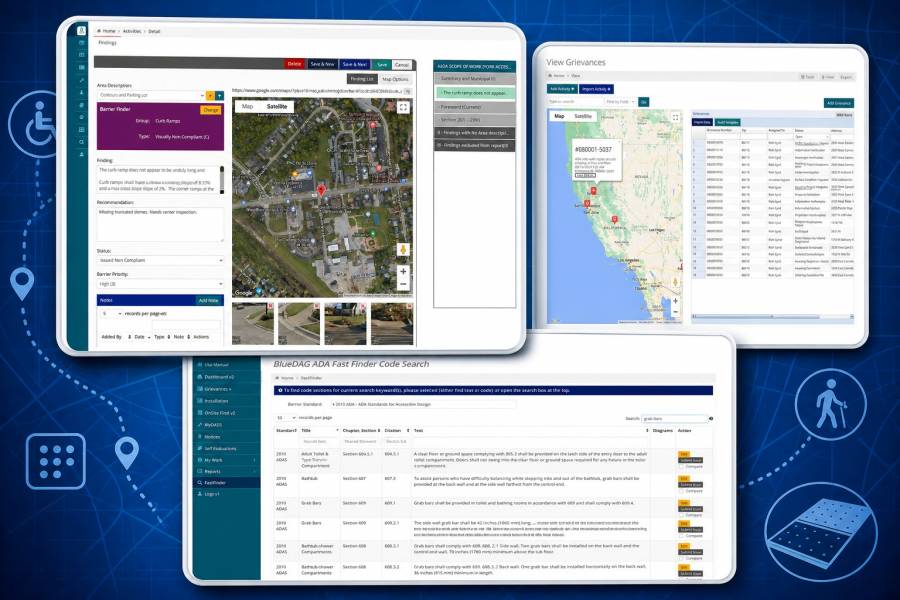
A centralized software platform is the operational core of any crowdsourced inspection program. BlueDAG’s Inspection Suite is an ADA and accessibility inspection and reporting system for existing or planned facilities and spaces. The system includes a web-based application and mobile app that let users identify and record accessibility barriers and generate reports with findings and recommendations. Platforms like BlueDAG are purpose-built for exactly this challenge: they support multiple simultaneous users in the field, enforce consistent finding standards, and roll all findings into a centralized program record.
Step 2: Train Field Staff to Inspect Consistently
The weakest point in any distributed inspection program is data quality. When two inspectors look at the same ramp and record different findings, they undermine the entire program. Consistent training is the fix.
What Field Staff Need to Know
Organizations can ensure compliance with ADA regulations by conducting regular accessibility surveys, implementing the improvements identified in those surveys, training staff on disability rights and accommodations, and staying informed about updates to accessibility standards.
Field inspectors do not need to be licensed architects or CASp professionals. They do need to understand:
- What elements to measure and in what sequence
- How to read a tape measure accurately and photograph findings with scale reference
- Which barriers are recordable versus which require professional judgment
- How to enter findings consistently into the shared platform
Inspections should be carried out by teams of at least two people, so one can assist with measurement-taking, and the other can record results on the checklist. For distributed programs, pairing a more experienced inspector with a trainee in each team both improves data quality and builds internal capacity over time.
Use Technology to Reduce Judgment Calls
Over 100 national and regional barrier standards are available via fast-access barrier finders and interactive checklists, and a mobile app can speed up capturing findings and photos in the field. When inspectors can look up the applicable standard for a door clearance or ramp slope directly in the app, they make fewer errors and work faster.
Enterprise-level features such as an Apprentice Mobile App, tandem inspectors, and Virtual Pre-Inspection enable teams to tackle their largest projects most productively without missing critical findings. The reported time savings for agencies using these tools are substantial; BlueDAG’s platform documentation reports that teams can cut overall inspection time by 50% or more with the right toolset.
Pro Tip: Run a pilot inspection at a single, well-understood facility before your full deployment. Use it as a calibration session, compare what each inspector recorded and reconcile differences. This is far more effective than classroom-only training.
Step 3: Sequence Your Portfolio to Maximize Coverage
Not every facility needs to be inspected on the same schedule. A smart sequencing strategy lets you demonstrate progress and address high-priority sites first.
Prioritize by Use, Risk, and Complexity
The ADA Checklist follows the four priorities in the Department of Justice ADA Title III regulations, and these priorities are equally applicable to state and local government facilities. Those four priorities move from accessible entry (Priority 1) through access to goods and services (Priority 2), restrooms (Priority 3), and any remaining access (Priority 4). Apply the same logic to your portfolio sequencing: inspect facilities the public uses most first, then work outward.
Not every facility needs the same level of inspection. Tiered inspection levels let agencies get the right depth for each program without paying for detail they don't need. A small storage shed used by maintenance staff has different inspection requirements than a public recreation center with a pool and accessible play area.
Track Against Your Transition Plan Requirements
The self-evaluation comprehensively reviews all public programs, activities, and services. To complement these efforts, the transition plan provides a framework to address structural and programmatic deficiencies to achieve accessibility, establishing a timeline and cost schedule.
The ADA requires a municipality, no matter the size, to review all aspects of its programs, services, and activities for compliance, often through a Self-Evaluation and Transition Plan. The self-evaluation process requires a clear understanding of the ADA Title II regulations, specifically the program access test as applied to existing facilities. Track every site your field teams inspect against that plan so inspection data translates directly into remediation priorities.
Pro Tip: Map your facility portfolio against a risk matrix before scheduling inspections. High-use, high-complexity sites with prior complaints or grievances go first. Remote, low-use facilities can follow once your field teams are well-calibrated.
Step 4, Control Data Quality and Maintain a Defensible Record
Verification completes the compliance cycle. A final inspection review typically confirms that dimensions match documented findings and operable parts function as required. Maintaining photographs, plans, pressure readings, and slope measurements for several years helps meet best practices and prevent claims.
Build a Quality Review Layer
Distributed inspections need a review layer between raw field data and the official program record. In practice, this means an experienced accessibility professional, your ADA coordinator, a designated senior inspector, or an outside consultant reviews a sample of findings from each field team before finalizing them.
ADA inspections produce defensible documentation. Site photos show the field context inspectors preserve: measuring accessible routes, confirming real-world conditions, and tying observations back to the program record. Every finding should include a photo and a measurement. Findings without documentation cannot be defended if a grievance or lawsuit follows.
Keep the Transition Plan Living
As programs, services, and activities evolve, public entities should periodically reassess to keep identifying barriers to accessibility. A transition plan written once and filed away does not satisfy this standard. Your inspection platform should feed the plan in real time so that remediated barriers are marked complete, and new findings are automatically incorporated.
BlueDAG’s Government Suite gives city and county agencies a centralized system to manage self-evaluation, maintain a living transition plan, track barrier remediation, and handle public grievances. The platform scales from small municipalities managing a compact facility portfolio to statewide implementations covering multiple jurisdictions.
Step 5: Scale the Program Statewide or Across Jurisdictions
The real power of a crowdsourced ADA inspection model comes when it scales beyond a single agency.
A Real-World Example
Oregon State Parks deployed 80 rangers using the BlueDAG Apprentice app and produced a complete, published transition plan within six months. That is a large, geographically distributed portfolio: trails, restrooms, day-use areas, campgrounds, and visitor centers spread across the entire state, completed in half a year using existing staff rather than outside consultants. The rangers did not become ADA experts overnight. They followed a structured methodology, used purpose-built tools, and their findings were reviewed and consolidated centrally.
The reported field-evaluation time savings when teams use purpose-built mobile tools are 3x compared to traditional paper-based methods. That multiplier is what makes statewide scale achievable.
Extend the Model Across Departments
After a self-evaluation, a public entity can develop a transition plan for structural changes and work with its departments and agencies to update policies and procedures. Each department- public works, parks and recreation, libraries, transit- can have its own inspection team operating within the same platform and the same program record. The ADA coordinator sees everything; department leads see their own facilities; field staff see only the sites assigned to them.
Common Mistakes That Derail Distributed Inspection Programs
Even well-intentioned programs run into predictable problems. Here is what to watch for.
- Deploying staff before the checklist is finalized. If the checklist changes mid-program, earlier inspections may not be comparable to later ones. Lock the inspection methodology before the first site visit.
- Skipping the pilot. One calibration session at a single site catches most inter-rater inconsistencies before they contaminate the full dataset.
- Treating the transition plan as a one-time document. State and local governments were required to develop a transition plan by 1993. Conducting a current survey is a good opportunity to update that plan. Plans from the 1990s almost certainly do not reflect the 2010 ADA Standards, which added requirements for swimming pools, play areas, and other recreation elements that did not exist in the original standards.
- Failing to document legal exposure. The findings in an accessibility inspection report not only provide information on accessible features or the lack thereof, but can also help clients avoid unexpected legal claims about a building’s accessibility. Document findings thoroughly so that your agency can demonstrate a good-faith compliance effort.
- Underestimating the importance of community input. Public entities must accept public comments on the self-evaluation and are strongly encouraged to consult individuals with disabilities and organizations that represent the disability community. Individuals with disabilities have unique perspectives and can provide valuable information about barriers preventing full access within the community.
Frequently Asked Questions
What is crowdsourcing in the context of ADA physical inspections?
Crowdsourcing ADA inspections means distributing field inspection tasks across multiple trained staff members, rather than relying on a single consultant, so that many sites can be evaluated simultaneously. Each person follows a standardized methodology and enters findings into a central platform. The result is faster portfolio coverage at lower cost, without sacrificing the consistency a defensible program requires.
How many staff members do we need to crowdsource ADA inspections effectively?
The answer depends on portfolio size and timeline. Inspections should be carried out by teams of at least two people, so one can assist with measurement-taking while the other records results on the checklist. For a portfolio of 50 facilities inspected over three months, a team of six to eight trained field staff working in pairs is a reasonable starting point. Oregon State Parks completed its statewide transition plan in six months with 80 staff members.
Does a crowdsourced inspection satisfy ADA Title II self-evaluation requirements?
A structured, well-documented field inspection that covers all program areas and is reviewed by a qualified accessibility professional can form the basis of a defensible self-evaluation. The ultimate responsibility for ADA compliance rests with each agency or jurisdiction. Agencies should review their completed ADA Transition Plan with legal counsel or a risk management team prior to proceeding with implementation. Always consult qualified legal or accessibility professionals to confirm your specific program meets applicable requirements.
What tools do field inspectors need for a physical ADA inspection?
Recommended on-hand tools include a clipboard, tape measure, level, door pressure gauge, camera, and bag. In a modern program, a smartphone or tablet running a purpose-built inspection app replaces the clipboard and paper checklist, and the camera is built in. The tape measure, level, and door pressure gauge remain essential for capturing the physical measurements that make findings defensible.
How often should a public agency update its ADA facility inspections?
Ongoing maintenance prevents compliance drift. In practice, agencies should re-inspect facilities after any renovation or alteration, after a complaint or grievance is filed, and on a regular cycle, typically every three to five years for facilities that have been fully remediated and more frequently for high-use sites. Reviewing the implementation plan each year to evaluate whether more access improvements have become readily achievable is a baseline best practice recommended by the DOJ’s own guidance.
Disclaimer: This article is provided for general informational and educational purposes only and is not intended to constitute legal advice or a legal opinion. While reasonable efforts have been made to provide accurate and current information, laws, regulations, standards, guidance, and interpretations may change, and no representation or warranty is made regarding the accuracy, completeness, or applicability of the information provided. References to tools, resources, or compliance approaches are for informational purposes only and do not guarantee compliance with the Americans with Disabilities Act (ADA) or any other applicable law or regulation. Readers should consult qualified legal counsel or other appropriate professionals regarding their specific circumstances. BlueDAG assumes no liability for any errors or omissions or for actions taken or not taken in reliance on the information contained in this article.
Sources
- ADA Accessibility Standards, U.S. Access Board. Federal accessibility standards for buildings and facilities. https://www.access-board.gov/ada/
- ADA Update: A Primer for State and Local Governments, ADA.gov. Title II requirements including self-evaluation and staff training. https://www.ada.gov/resources/title-ii-primer/
- ADA Self-Evaluation & Transition Plans, Ohio Department of Transportation. Template and guidance for public agencies. Title II applies to all
- ADA Checklist for Existing Facilities, Northwest ADA Center / University of Washington. Facility survey checklist based on 2010 ADA Standards. https://www.oregon.gov/oha/HSD/OHP/Contractor%20Workgroups%20CMS%20State%20Alignment%20Meeting/2010%20ADA%20Standards%20Checklist_March%202015%20Edition(1).pdf
- BlueDAG Inspection Suite, BlueDAG LLC. ADA inspection platform for government agencies. https://www.bluedag.com/the-inspection-suite/
- BlueDAG Solutions for Government, BlueDAG LLC. Government suite features and Oregon State Parks case reference. https://www.bluedag.com/solutions.html
- BlueDAG ADA Inspections, BlueDAG LLC. Tiered inspection services, pricing, and field documentation standards. https://www.bluedag.com/inspections.html
- Cross-Site Comparison of Crowdsourced and Authoritative Accessibility Maps, ACM CHI Conference. Peer-reviewed research on crowdsourcing accessibility data. Crowdsourced accessibility maps help
- Toward Satisfactory Public Accessibility: A Crowdsourcing Approach, arXiv / peer-reviewed research. Cost-effectiveness of crowdsourcing for accessibility data collection. https://arxiv.org/abs/2409.08459
- Inspect Facilities for Accessibility, Preferred Governmental Insurance Trust. Guidance on two-person inspection teams and tools. https://pgit.org/inspect-facilities-for-accessibility-to-enable-the-disabled/
- ADA Standards for Accessible Design Compliance Guide, Rimkus. Practical guide to conducting ADA surveys and maintaining documentation. https://rimkus.com/article/ada-standards-accessible-design-compliance-guide/
- Accessibility and ADA Surveys Consulting, Partner ESI. Overview of accessibility survey professionals and common physical barriers. https://www.partneresi.com/services/building-assessments-engineering/accessibility-and-ada-surveys/
- Administrative Requirements for Title II Public Entities, Northeast ADA Center. Requirements for ongoing self-evaluation and transition plan updates. https://northeastada.org/resource/administrative-requirements-for-title-ii-public-entities
- ADA Self-Evaluation and Transition Plans Action Guide, ADA Title II Action Guide. Steps for completing a compliant self-evaluation and transition plan. https://adaactionguide.org/action-steps
- ADA Non-Compliance: What Happens When Cities Do Not Comply, ADA Solutions. Municipal enforcement history and settlement examples. More than 142 local government
- ADA Inspection Cost Guide, CCIS. Average cost ranges for professional ADA inspections. https://consultccis.com/blog/the-average-cost-of-ada-inspections-what-you-need-to-know
- How to Develop an ADA Transition Plan, Kimley-Horn. Eight-step process for achieving ADA compliance. https://www.kimley-horn.com/news-insights/perspectives/how-to-develop-ada-transition-plan/
- ADA Checklist for Existing Facilities, CORADA / DOJ. Priority framework for barrier removal planning. https://www.corada.com/documents/ada-checklist-for-existing-facilities/whole-document