The Hidden Facility ADA Barriers Many Agencies Miss
More than three decades after the Americans with Disabilities Act became law, many public facilities are still failing to meet the needs of the people they are supposed to serve. According to the latest data from the CDC’s Behavioral Risk Factor Surveillance System, more than 1 in 4 adults in the United States reported having a disability in 2022. That is a substantial portion of every community visiting courthouses, libraries, parks, transit stations, and city halls every single day. Yet, more than three decades after the ADA, people with disabilities continue to face architectural and other barriers to community inclusion and participation.
The barriers that make the news are the obvious ones: a building with no ramp, or a restroom with a door too narrow for a wheelchair. The barriers that actually cost agencies money and deny access are the quieter ones. They accumulate over time, slip through audits, and get missed because no one is looking in the right place. This article breaks down what those hidden barriers are, why they persist, and how public agencies can begin to address them systematically.

Key Takeaways
- Scale of exposure is massive: More than 25% of adults in the U.S. reported having a disability in 2022, meaning virtually every public facility interacts with this population daily. Audit your facility as if one in four visitors relies on accessible features to function.
- Fines are significant and apply to first-time violations: ADA compliance is a continuous maintenance obligation, and the Department of Justice has made that point with $75,000 fines for a single first-time violation and $150,000 for repeat infractions. Do not wait for a complaint to begin your review.
- Compliance drift is the primary culprit: The pattern in many ADA violation cases is identical: the original building was compliant, but a sequence of small operational decisions over five or ten years drifted it out of compliance. A maintenance team replaces a door closer. A facilities supervisor moves a directional sign. A custodian places a recycling bin in the accessible route. Each individual action is innocuous. The aggregate is an enforceable violation.
- Digital barriers are now equally enforceable: The Department of Justice published a rule extending state and local governments’ compliance deadlines for its 2024 web accessibility rule under Title II of the ADA, and the rule covers state and local governments requiring that virtually all web content and mobile applications be accessible to people with disabilities. Agencies that focus only on physical space are missing a growing front of legal exposure.
- Documentation is a legal shield: Courts and regulators favor organizations that can show an active barrier-removal plan supported by inspections, maintenance logs, and defined responsibilities. Start building that paper trail now.
Quick-Start Prioritization Framework
Barrier Category | Best First Action | Effort Level | Time to Results |
|---|---|---|---|
Accessible Parking | Physical audit + slope measurement | Low | Days |
Accessible Routes (Sidewalks/Corridors) | Walk the route with a tape measure | Low | Days to Weeks |
Restroom Compliance | Grab bar placement + stall clearance check | Medium | Weeks |
Signage and Wayfinding | Visual inspection + ISA signage audit | Low | Days |
Transition Plans and Documentation | Appoint ADA Coordinator, begin self-evaluation | Medium | Weeks to Months |
Digital Accessibility (Websites/Apps) | Automated audit tool + manual screen reader test | Medium-High | Months |
Start here if you are:
- A small agency or municipality: Begin with the parking lot and accessible routes. These are the most frequently cited violations and the fastest to photograph, measure, and remediate.
- A mid-size public entity (50+ employees): Prioritize completing or updating your ADA Self-Evaluation and Transition Plan. The ADA mandates that all State and Local Government agencies employing 50 or more individuals must undertake an ADA Self-Evaluation and Transition Plan.
- A large agency with digital services: Move immediately on your website and mobile app audit. The current deadlines are April 26, 2027 for public entities serving populations of 50,000 or more, and April 26, 2028 for public entities serving populations of less than 50,000. A year or two moves faster than agencies expect.
Barriers Hiding in Plain Sight: Parking Lots and Accessible Routes
Why Parking Is the Most Cited Starting Point
Most accessibility failures begin before a visitor reaches the front door. ADA parking compliance is among the most frequently cited violations. The problem is both structural and operational. A lot may have been built to code years ago, but pavement shifts, paint fades, and slopes change over time without anyone updating the inspection record.
Since fading paint, shifting grades, and outdated layouts are common culprits of noncompliance, maintaining these elements is just as important as installing them. A compliant parking lot shapes every visitor’s first impression. In practice, that means agencies need to treat parking lot accessibility as an ongoing maintenance item, not a one-time construction checkbox.
Pro Tip: At minimum, schedule annual slope measurements of accessible parking stalls and access aisles. A digital level costs less than $50. A DOJ complaint costs up to $75,000. Photograph everything and date every record.
To avoid violations, parking spots must be located on flat ground, as close as possible, and on the easiest route to the facility's entrance door. A clear access aisle must run alongside the space to provide a person with a disability with safe access from the vehicle to the business. Van-accessible spaces with the correct aisle widths are frequently missing or incorrectly marked, especially in older lots.
Accessible Routes and Sidewalks: The Overlooked Connection
Once someone leaves an accessible parking stall, the path to the building door must remain fully accessible. The most common ADA sidewalk violations are excessive cross slope, trip hazards above one-quarter inch, missing curb ramps, inadequate sidewalk width, and damaged detectable warning surfaces. Each of these can appear gradually through normal weathering and deferred maintenance.
One particularly striking finding: missing or noncompliant curb ramps are among the most frequently cited ADA violations in municipal audits. Baltimore, for example, found that only 1.3% of its curb ramps met ADA standards. If your agency has not walked and measured every curb ramp on your accessible route recently, that figure should prompt immediate action.
Every public route must maintain a minimum 36-inch clear width under the 2010 ADA Standards for Accessible Design. Objects protruding from walls, fire extinguisher cabinets, signage brackets, and mail kiosks are common and underappreciated barriers. Objects mounted on walls or posts cannot project more than 4 inches into the walkway if their leading edge is between 27 and 80 inches above the ground. This protects people who use canes for navigation, since a cane detects objects at ground level but cannot detect a wall-mounted sign or fire extinguisher cabinet that protrudes at chest height.
Restrooms and Interior Features: Where Compliance Quietly Erodes
The Grab Bar Problem
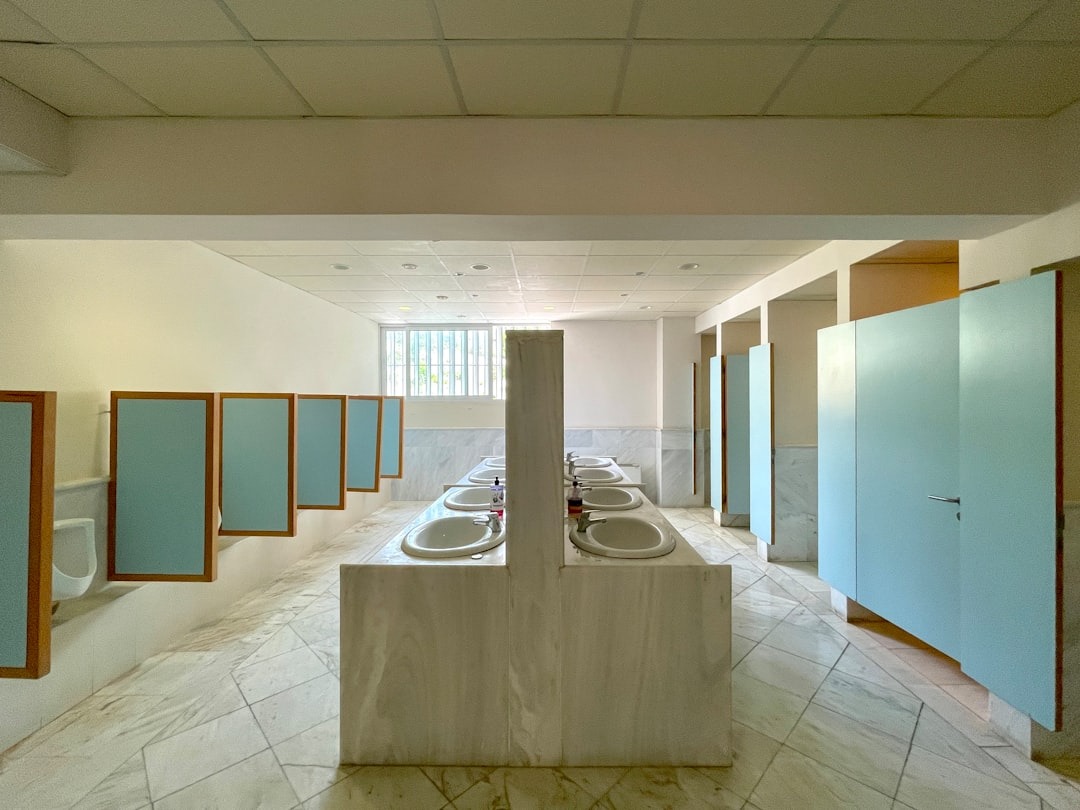
Restroom accessibility is one of the most technically detailed areas of ADA compliance and one of the most commonly cited in real audits. Common audit issues include noncompliant parking slopes, missing van access aisles, heavy entrance doors, counters that are too high, inaccessible fitting rooms, misplaced restroom grab bars, and protruding objects that create hazards for blind visitors. Grab bar placement, in particular, is often wrong even in facilities originally built to code.
Hundreds of specific ADA regulations must be met for restrooms to be compliant. Restrooms must include an extra-wide stall for wheelchairs or other assistive devices, maintain consistent heights and locations, and use automatic or hand-operated controls. When a grab bar is removed for repair and reinstalled at the wrong height, or when a stall door swing is reversed during a renovation, the restroom can become non-compliant overnight.
Pro Tip: After any restroom repair or renovation, walk through the space with a tape measure and the ADA.gov restroom compliance checklist before signing off on the work order. A five-minute check prevents months of liability.
The Temporary Barrier Trap
Seasonal and temporary conditions are a source of violations agencies routinely underestimate. Seasonal displays that narrow aisles, outdoor dining setups that block accessible routes, snow piled into curb ramps, and broken door openers are all common failures. The law does not grant a temporary exception for temporary conditions. Accessibility is judged by the user’s actual experience on the day of use, not by an architectural drawing.
This matters for public agencies that host events, outdoor programming, farmers markets, or holiday installations. Review every temporary setup through an accessibility lens before it goes up.
The Compliance Drift Problem: How Facilities Lose Ground Over Time
Small Decisions, Big Consequences
In my experience reviewing how public agencies approach ADA compliance, the most consistent finding is not that buildings were built wrong; it is that they were maintained inconsistently. Public buildings, courthouses, libraries, and city halls accumulate accessibility drift between formal audits: a door closer is replaced with a non-compliant model, a grab bar is removed for repair and reinstalled at the wrong height, a curb ramp’s detectable warnings wear away.
According to ADA.gov’s guidance on city governments, city governments often fail to ensure that the whole range of the city’s services, municipal buildings, and programs meet Title II’s program access requirements, meaning people with disabilities are unable to participate in public meetings, attend city functions, or gain access to various programs and services.
The fix is structural, not reactive. The cities that defend their compliance position successfully are the ones who can produce a documented inspection history at every accessible component. Documentation is not a bureaucratic inconvenience. It is the evidence that stands between an agency and an enforcement action.
Signage: The Most Visible, and Most Ignored, Barrier
Accessible signage is one of those areas where violations are visible to anyone who walks through a facility, yet agencies routinely overlook it. Accessible parking signage is highly visible to a potential plaintiff, so it pays to keep it compliant. Additionally, noncompliant accessible parking signage can be a red flag that the building has interior elements that are not compliant.
Provide signage that directs people with disabilities to accessible features and spaces in a facility. In practice, that means interior wayfinding signs, restroom identification signs, and accessible entrance signs must meet specific height, placement, contrast, and Braille requirements. Even well-maintained public buildings frequently have non-compliant signage because it falls outside the maintenance team’s standard checklist.
Pro Tip: Add signage compliance to your annual facilities walkthrough using the U.S. Access Board's technical guidance. Include photo documentation showing mounting height, character height, and Braille presence.
Transition Plans and Self-Evaluations: The Obligation Agencies Skip
What the Law Actually Requires
Many agencies believe that if their building passes an inspection, they are ADA compliant. The Americans with Disabilities Act has been around since 1990, but ADA compliance still trips up experienced practitioners. Part of the problem is that the rules are scattered across federal law, state codes, and local amendments.
Title II of the ADA requires all public agencies, regardless of size, to ensure that their services, programs, and activities are accessible to persons with disabilities. Compliance includes conducting a self-evaluation of building facilities, rights-of-way facilities, and communications to identify any accessibility obstacles or issues that need to be addressed.
For agencies with 50 or more employees, public entities must designate an ADA Coordinator and establish a grievance procedure to allow prompt resolution of accessibility concerns. Many agencies have never completed a formal self-evaluation, and even those that have may be working from documents that are a decade or more out of date.
What a Self-Evaluation Should Cover
When conducting the self-evaluation process, agencies should review each department that interacts with the community; boards and commissions; facilities, curb ramps, intersections, and sidewalks; and the municipality’s employment practices. A self-evaluation that covers only physical facilities and misses programs, services, policies, or communications is incomplete.
The regulation requires that public entities provide an opportunity for people with disabilities and other interested individuals or organizations to review and comment on the self-evaluation and transition plan. Involving end users in the process will generate creative, effective solutions. Involving people with disabilities in decision-making will strengthen accountability and ensure wise use of limited public resources.
Tools like BlueDAG are built specifically to help public agencies organize, document, and manage their ADA self-evaluation and transition plan process so that the work is structured, auditable, and defensible.
Digital Accessibility: The Barrier Most Physical-Focused Agencies Miss
A Growing Legal Front
Physical-space compliance teams often treat website accessibility as someone else’s problem. That assumption is increasingly costly. Seyfarth Shaw’s ADA litigation data found that more than 8,600 ADA lawsuits were filed in 2025, the majority targeting a lack of accessibility in public spaces and online environments. Public agencies face the same exposure as private entities.
Research from AudioEye found an average of 307 accessibility violations per page on government websites. That figure is not a crisis to despair over; it is a starting baseline to measure against. The first step is running an audit to understand your actual number.
The DOJ issued final regulations under Title II covering state and local governments requiring that virtually all web content and mobile applications be accessible to people with disabilities. Under the extended timeline set by DOJ’s 2026 Interim Final Rule, the ADA Title II compliance deadline for web accessibility is April 26, 2027 for public entities with populations of 50,000 or more, and April 26, 2028 for smaller entities and special district governments, both dates extended by one year by the Department of Justice in April 2026.
The required standard is WCAG 2.1 Level AA. Compliance at that level means ensuring that web content is perceivable, operable, understandable, and robust for users relying on assistive technology. Automated tools help, but they do not catch everything. Automated tools like WAVE, AXE, and Google Lighthouse catch major issues quickly, but they do not catch everything. Manual testing with a screen reader is necessary.
Pro Tip: Treat digital accessibility as a parallel track to physical compliance, not a separate project. The current deadlines are April website accessibility audit and implementing changes takes significant effort. Starting early is the only reliable strategy.
Frequently Asked Questions
What is an ADA Transition Plan and does my agency need one?
An ADA Transition Plan is a formal document that identifies physical barriers in a public entity’s facilities and sets a schedule for removing them. Public entities with 50 or more employees must develop a transition plan that details any structural changes needed to achieve program access and specifies a time frame for completion. If your agency employs 50 or more people and has not completed one, you are already out of compliance, and auditing your facilities is a good place to start.
How much can an agency be fined for an ADA violation?
The Department of Justice can impose civil penalties for ADA violations. For a first violation, fines can be up to $75,000. For subsequent violations, fines can be as high as $150,000. State and municipal fines may apply on top of federal penalties, so the full cost of a single unaddressed barrier can exceed six figures. Proactive auditing and documented remediation plans significantly reduce exposure.
What are the most common physical ADA violations found in public facilities?
Parking lots, restrooms, and entrances are the most common areas of non-compliance. Within those spaces, the most frequently flagged issues include noncompliant accessible parking stall slopes, missing or incorrectly marked van-accessible spaces, misplaced grab bars in restrooms, inaccessible entrance doors (due to the force required to open them or a lack of automatic openers), and obstructed accessible routes. Any good compliance review should prioritize these areas first.
Does ADA compliance cover our agency’s website and digital services?
Yes. On April 24, 2024, the U.S. Department of Justice issued a final rule under Title II of the Americans with Disabilities Act requiring state and local public entities to ensure that their web content and mobile applications are accessible to persons with disabilities. The deadlines were extended in April 2026, giving larger entities until April 2027 and smaller entities until April 2028. Agencies should begin auditing now and build remediation into their operating plans.
What should we do if we find barriers during a self-evaluation?
Organizations should not wait for a complaint to identify barriers. They should survey each location, rank issues by life-safety and usability impact, estimate remediation costs, and create a schedule. Document every finding with photographs and measurements. Prioritize life-safety barriers first, then high-impact usability barriers, and then lower-priority cosmetic or administrative issues. Agencies that can show a documented, actively managed barrier-removal plan are in a significantly stronger legal position than those that cannot.
Disclaimer: This article is provided for general informational and educational purposes only and is not intended to constitute legal advice or a legal opinion. While reasonable efforts have been made to provide accurate and current information, laws, regulations, standards, guidance, and interpretations may change, and no representation or warranty is made regarding the accuracy, completeness, or applicability of the information provided. References to tools, resources, or compliance approaches are for informational purposes only and do not guarantee compliance with the Americans with Disabilities Act (ADA) or any other applicable law or regulation. Readers should consult qualified legal counsel or other appropriate professionals regarding their specific circumstances. BlueDAG assumes no liability for any errors or omissions or for actions taken or not taken in reliance on the information contained in this article.
Sources
- CDC Disability and Health Data System (2022 BRFSS), Centers for Disease Control and Prevention. Over 70 million U.S. adults reported having a disability. Over 70 million U.S. adults reported having a disability
- The ADA and City Governments: Common Problems, ADA.gov / U.S. Department of Justice. Common Title II failures by city governments. https://www.ada.gov/resources/ada-city-governments/
- ADA Standards for Accessible Design, U.S. Access Board. 2010 standards for new construction and alterations. https://www.access-board.gov/ada/
- ADA Update: A Primer for State and Local Governments, ADA.gov. Self-evaluation and transition plan requirements. https://www.ada.gov/resources/title-ii-primer/
- ADA Requirements for Public Accommodations in 2025, Know-the-ADA.com. Common physical barrier audit findings. https://know-the-ada.com/understanding-the-newest-ada-requirements-for-public-accommodations/
- ADA Facility Compliance Maintenance for Public Buildings, OxMaint. Compliance drift and ongoing maintenance obligation. https://oxmaint.com/industries/government/ada-facility-compliance-maintenance-for-public-buildings
- ADA Title II Web Rule, State and Local Governments: First Steps, ADA.gov / DOJ. Digital accessibility compliance deadlines and extended IFR. https://www.ada.gov/resources/web-rule-first-steps/
- DOJ Extends Public Entities' Compliance Deadline, Jackson Lewis. 2026 extension of ADA Title II web accessibility deadlines. https://www.jacksonlewis.com/insights/doj-extends-public-entities-compliance-deadline-ada-related-website-accessibility-hhss-may-2026-deadline-still-looms
- ADA Sidewalk Compliance 2026: Complete Glossary and Guide, Wright Construction Company. Most common ADA sidewalk violations. https://wrightconstructioninc.com/post/ada-sidewalk-compliance-glossary/
- ADA Requirements for Parking: Compliance and Penalties, AccessibilityChecker.org. DOJ civil penalty structure for ADA violations. https://www.accessibilitychecker.org/blog/ada-requirements-for-parking-standards-compliance-and-penalties/
- Disability Statistics in the U.S., AudioEye. ADA lawsuit data and government website violation averages. Seyfarth Shaw's ADA litigation
- ADA Compliance Guide for Contractors (2026), ProJul. ADA as a growing construction litigation category. https://projul.com/blog/construction-ada-compliance-guide/
- How to Develop an ADA Transition Plan, Kimley-Horn. Transition plan components and self-evaluation scope. https://www.kimley-horn.com/news-insights/perspectives/how-to-develop-ada-transition-plan/
- ADA Self-Evaluation and Transition Plans, ADA Action Guide. Team approach and community input in the self-evaluation process. https://adaactionguide.org/action-steps
- Title II Compliance Timeline: Key Dates and Deadlines, UsableNet. WCAG 2.1 Level AA and extended government deadlines. https://blog.usablenet.com/title-ii-compliance-deadline-2026
- The Americans with Disabilities Act and Equal Access to Public Spaces, NCBI / Syracuse University. Peer-reviewed review of ADA effectiveness and ongoing barriers. peer-reviewed research on ADA effectiveness and barriers
- BlueDAG ADA Transition Plan Management, BlueDAG. Structured tools for ADA self-evaluation and compliance documentation. https://www.bluedag.com/