Five Ways to Fix the ADA Inspection Backlog That’s Slowing Your Public Agency’s Progress

Public agencies across the country are facing a growing crisis that too few talk about openly: the ADA inspection backlog. About 45.8 million Americans live with a disability, representing 13.7% of the U.S. population, the highest recorded share to date. Every one of those individuals depends on accessible public spaces, sidewalks, facilities, and services. Yet the inspection work required to identify and fix accessibility barriers keeps piling up faster than most agencies can process it.
The consequences are real. 8,800 web accessibility lawsuits were filed in 2024 alone, a 7% increase from 2023. When you factor in physical ADA barriers, the legal and financial exposure compounds quickly. Agencies that let their inspection backlogs grow leave themselves open to complaints, enforcement actions, and settlement costs that strain already tight public budgets.
The good news is that this problem is solvable. Five proven strategies can help your agency cut through the backlog, move faster, and build a defensible compliance record without burning out your team or blowing the budget.
Key Takeaways
- Inspection backlogs expose agencies to serious legal risk: ADA lawsuit settlements now average $125,000 or more, and the risk accelerates the longer barriers go uninspected and unaddressed. Treat the backlog as a financial liability, not just an administrative inconvenience.
- Prioritization beats brute force: A sound prioritization approach considers spatial, social, and functional criteria, including population density and areas with higher concentrations of vulnerable residents. Start with high-impact locations, not the easiest ones.
- Technology can cut inspection time by half or more: Thanks to advanced inspection software engines and smart checklists, users of purpose-built ADA inspection platforms can reduce inspection and report-generation time by 50% to 75%. That efficiency gain alone can transform a multi-year backlog into a manageable program.
- Staff capacity can be expanded without hiring: Cross-training existing employees and deploying structured inspection tools lets agencies multiply field coverage without adding headcount.
- A living transition plan turns data into momentum: A transition plan creates an actionable, trackable method for addressing barriers, and keeping it current is what separates agencies that make steady progress from those that keep restarting from scratch.
Quick-Start Prioritization Framework
Use this table to match your agency’s current situation to the strategy that will deliver the fastest results.
Strategy | Best For | Effort Level | Time to Results |
|---|---|---|---|
Risk-Based Inspection Prioritization | All agency sizes facing a site backlog | Low | Weeks |
Virtual Pre-Inspection | Agencies with large PROW inventories | Low | Days |
Cross-Training Existing Staff | Agencies with limited inspector headcount | Medium | 1-3 months |
Purpose-Built Inspection Software | Any agency doing manual or paper-based audits | Medium | Weeks |
Grievance-Driven Feedback Loops | Agencies with active public complaints | Low | Days |
Start here if you’re:
- A small or mid-size agency with a tight budget: Virtual pre-inspection technology delivers the highest return for the lowest cost; tackle the desk work before the fieldwork.
- A large agency with many facilities: Risk-based prioritization and purpose-built software work together to systematically move through a large portfolio.
- An agency already receiving complaints: Grievance-driven feedback loops let you address the highest-visibility barriers immediately while the broader program catches up.
Strategy 1: Build a Risk-Based Inspection Priority Matrix
Why “First In, First Out” Fails Public Agencies
The most common reason ADA inspection backlogs grow is that agencies treat all sites as equally urgent. They inspect in the order complaints come in, or they work through facilities alphabetically. That approach ignores the reality that some barriers put community members at immediate risk while others are minor inconveniences. Working through the list randomly means the most dangerous conditions may sit unaddressed for years.
A backlog sorted by risk tier lets agencies fund the highest-liability locations first, not the loudest complaint. This reframe alone, from reactive to risk-informed, changes the pace and effectiveness of a compliance program.
How to Build Your Priority Matrix
A sound prioritization approach considers a combination of spatial, social, and functional criteria, including population density, with areas with higher concentrations of residents, particularly vulnerable populations, prioritized to enhance safety and accessibility for the greatest number of people. Translated into practice, this means your priority list should weight three factors:
- Proximity to transit stops, medical facilities, and schools
- Volume of pedestrian traffic at the location
- Severity of the barrier (a missing curb ramp outranks a minor slope deviation)
Public works leaders must use data to prioritize sidewalk repair backlog tasks. A clear system helps cities fix the worst issues first, reducing legal risk and using local funds effectively.
Pro Tip: Populate your priority matrix before you begin field inspections. Using satellite imagery and GIS data, your team can pre-score sites at the desktop level and schedule fieldwork in the highest-risk zones first. This approach prevents inspectors from spending their first weeks on easy, low-impact locations.

Strategy 2: Leverage Virtual Pre-Inspection to Cut Field Time in Half
The Desk-First Approach to a Backlog
One of the most underused tools in public agency ADA compliance is the virtual pre-inspection. The concept is straightforward: before a single inspector sets foot in the field, a staff member uses satellite and street-level imagery to conduct a preliminary review of public right-of-way assets. Staff can assess and document slopes, curb conditions, ramp placements, and intersection configurations without leaving the office.
Virtual Pre-Inspection allows a desktop pre-assessment of public right-of-way by leveraging Google satellite and Street View imagery, and an average of 50% of the assessment workload can be completed without leaving the office, with the results used to prioritize fieldwork.
In my experience, agencies that adopt this approach find their field teams become dramatically more efficient almost immediately. Instead of spending half a day driving between low-priority locations, inspectors arrive at each site already knowing what to look for.
What Virtual Pre-Inspection Can and Cannot Do
Virtual review is a triage tool, not a replacement for field inspections. It identifies obvious barriers and flags sites for detailed review, but it cannot measure precise slopes, verify tactile surface conditions, or confirm equipment clearances. The right workflow is desktop triage followed by targeted field verification. That sequence cuts total inspection hours by up to half.
Detailed and annotated reports can be generated instantly, saving countless hours versus manual preparation. When the pre-inspection data feeds directly into a structured reporting system, the documentation burden shrinks even further.
Strategy 3: Cross-Train Existing Staff to Expand Inspector Capacity
You Have More Inspectors Than You Think
Most public agencies assume that ADA inspections require a dedicated accessibility specialist. That assumption is one of the biggest reasons backlogs persist. In practice, structured inspection tools and smart checklists can enable employees who are not ADA specialists to conduct accurate field evaluations under a qualified coordinator’s direction.
Purpose-built inspection software allows inexperienced personnel to perform on-site inspections. The field inspector can point and click through a simple series of questions and take photos. That workflow turns a park ranger, a public works technician, or a facilities maintenance employee into a capable data collector.
A real-world example shows what this looks like in practice. After subscribing to inspection software and completing on-site ADA inspector training, one agency deployed 80 park rangers to perform inspections, and within six months, they published the final draft of their transition plan. That kind of result comes from multiplying inspector capacity rather than waiting for specialist hires.
Setting Up a Cross-Training Program
The ADA National Network’s ADA Title II Action Guide outlines the full range of coordination responsibilities that an ADA Coordinator must cover. Cross-training works best when staff understand those responsibilities and the ADA Coordinator can review and validate their field findings instead of conducting every inspection personally.
An ADA Coordinator must ensure the public entity they work for meets its Title II responsibilities and should work with the entity to comply with all Title II requirements. Cross-training scales that mandate by giving the coordinator more eyes and data inputs in the field.
Pro Tip: Pair your cross-training program with standardized mobile app workflows. When every inspector, regardless of experience level, follows the same guided checklist, the data is consistent and immediately usable for transition plan updates. Consistency is what makes the backlog data defensible, not the number of inspectors.
Strategy 4: Replace Manual Processes with Purpose-Built Inspection Software
The Hidden Cost of Paper-Based Compliance
Many agencies are still running their ADA inspection programs on spreadsheets, paper forms, and email chains. The inspection data sits disconnected from the transition plan, the grievance log, and the capital budget. Coordinators spend hours manually compiling reports that could be generated in minutes. That inefficiency is not just an inconvenience; it actively inflates the backlog by consuming staff time that should go toward inspections.
The most effective approach is to treat public right-of-way accessibility as an ongoing municipal program, not a series of isolated fixes. Paper-based processes make that ongoing program nearly impossible to sustain because they fragment data across disconnected files and individuals.
What Purpose-Built Software Does For You
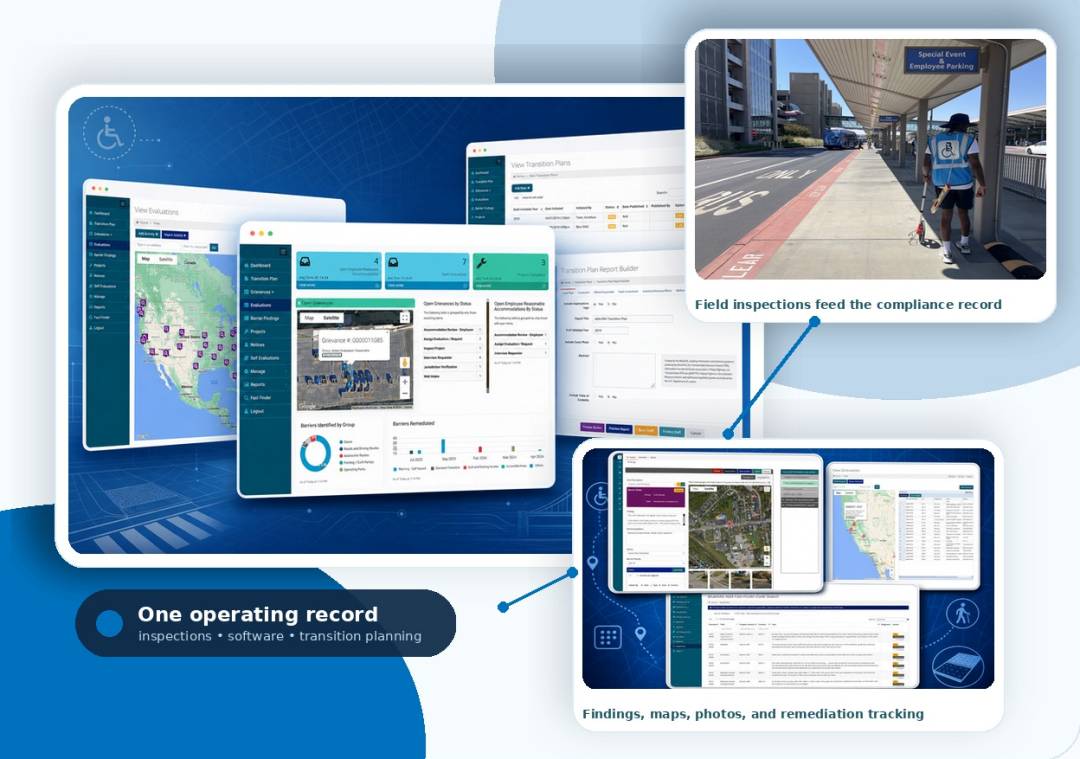
Platforms like BlueDAG help public agencies turn ADA self-evaluations, inspections, transition plans, grievances, and remediation tracking into a living accessibility program. That integration is the core value: when inspection findings flow automatically into the transition plan and the remediation tracker, the coordinator has a single, current picture of the agency’s compliance status at all times.
Purpose-built platforms can cut overall inspection time by 50% or more, with over 100 national and regional barrier standards accessible via barrier finders and interactive checklists. That means inspectors spend their time evaluating, not searching for the applicable standard.
Findings can be grouped by site standard, severity, department, cost, and remediation path so agencies can make practical decisions. That grouping capability turns a raw inspection database into an actionable work plan.
For agencies managing public right-of-way at scale, BlueDAG’s platform at www.bluedag.com is designed specifically for this use case, including GIS data export and integration with existing agency systems.
Pro Tip: Before selecting any software tool, confirm it exports data in formats your GIS, capital planning, and finance teams can already use. The goal is a system that connects inspection data to budget decisions, tools that only produce PDF reports create a new data silo instead of eliminating one.
Strategy 5: Use Grievances as a Real-Time Backlog Triage Signal
Your Residents Are Already Telling You Where to Look
A well-functioning grievance management process is not just a legal requirement. It is a live signal about where barriers are causing real problems in your community right now. A public entity must adopt and publish a complaint or grievance procedure that members of the public can use, and the ADA Coordinator or their designee must investigate and quickly resolve all complaints received about the public entity’s failure to comply with its Title II responsibilities.
When you track grievances systematically, patterns emerge fast. Three complaints in six months about the same intersection tell you exactly where to deploy your next inspection team.
Connecting Grievances to the Inspection Queue
Public entities with 50 or more employees must have a grievance procedure that gives people who believe they have been discriminated against because of their disability a formal process to make their complaint known. But most agencies manage those grievances in isolation from their inspection schedule. The fix is simple: every substantiated grievance should generate an inspection work order for the relevant site or barrier type.
When constituents report an accessibility issue or need an accommodation, agencies with integrated grievance tools can respond effectively with structured, assignable workflows. That closed-loop process- complaint received, site inspected, barrier documented, remediation scheduled- is what demonstrates to the community and to regulators that the agency is taking accessibility seriously.
The legal stakes reinforce the urgency. The extension of the DOJ’s Title II digital deadline does not pause ADA Title II enforcement more broadly. Private litigants can still bring claims based on the underlying nondiscrimination obligation, and agencies that ignore accessibility for another year face the same settlement pressure, injunctive relief, and attorneys’ fees exposure as before.
Common Mistakes That Make the Backlog Worse
Treating the Transition Plan as a One-Time Project
Not having an updated, compliant ADA Transition Plan may be affecting people in your community, and a static, outdated plan provides little protection if the agency faces a complaint or enforcement action. Agencies that complete a transition plan and file it away without maintaining it often find themselves starting over after a few years, which resets the backlog rather than shrinking it.
Waiting for Staff Openings to Be Filled
The inspector shortage is real, but waiting for a hire to start compliance work compounds the backlog every quarter. Cross-training, virtual pre-inspection, and structured software all exist precisely to address capacity constraints without depending on new headcount.
Inspecting Without Feeding the Transition Plan
Effective compliance programs adopt standard drawings aligned with current guidance, train inspectors and designers, maintain a living inventory, and require accessibility review at concept, design, bid, and closeout stages. Inspections that produce reports without feeding into a centralized transition plan create a false sense of progress; the data exists but doesn't drive decisions.
Frequently Asked Questions
What is an ADA inspection backlog and why does it happen?
An ADA inspection backlog occurs when the volume of facilities, public rights-of-way, and other assets that need accessibility evaluation exceeds the agency’s current inspection capacity. Title II of the ADA applies to all public agencies, regardless of size, to ensure their services, programs, and activities are accessible to persons with disabilities, including conducting self-evaluations of building facilities, rights-of-way facilities, and communications to identify accessibility obstacles. Backlogs develop because the scope of that mandate is large and most agencies have limited staff dedicated to inspection work.
Are all public agencies required to conduct ADA inspections?
Yes. Every state and local government must perform an ADA self-evaluation of its current services, policies, practices, and associated facilities; modify services and policies inconsistent with Title II requirements; and develop a Transition Plan for needed structural changes. The depth of the transition plan requirement depends on agency size, with more detailed obligations applying to agencies with 50 or more employees.
What are the consequences of not addressing the inspection backlog?
The consequences include legal exposure, financial liability, and harm to community members with disabilities. Businesses may face fines of up to $75,000 for a first violation and up to $150,000 for subsequent violations, and public agencies face enforcement through the DOJ and federal funding conditions. Beyond fines, non-compliance can result in lawsuits, with settlements now averaging $125,000 or more, and most importantly, the denial of equal access to citizens with disabilities.
How does a transition plan help reduce the backlog?
A self-evaluation identifies potential barriers that impede the participation of individuals with disabilities in the agency’s programs, services, and activities. A transition plan then creates an actionable, trackable method for addressing those barriers, detailing structural and programmatic changes and specifying a time frame for their completion. A maintained transition plan turns inspection findings into a prioritized work program, so every inspection moves the agency forward rather than generating unused data.
How can a small agency with limited staff realistically tackle a large inspection backlog?
Small agencies should focus on three things: virtual pre-inspection to reduce fieldwork hours, cross-training non-specialist staff using guided inspection checklists, and adopting purpose-built software to eliminate manual reporting time. With a powerful standards engine and innovative smart checklists, a 50% to 75% reduction in inspection and reporting time is achievable, and report generation becomes nearly instantaneous, allowing teams to go from gathering findings to a completed report in minutes. Those efficiency gains make a meaningful backlog reduction achievable even with a small team.
Conclusion
The ADA inspector backlog is one of the most consequential operational challenges facing public agencies today. The mandate is large, inspector supply is constrained, and the legal and community stakes are high. But the agencies making real progress aren't the ones waiting for more resources; they are the ones working smarter with what they already have.
Risk-based prioritization, virtual pre-inspection, cross-trained staff, purpose-built software, and grievance-driven feedback loops are five strategies any agency can begin implementing today. Used together, they create a self-reinforcing compliance program that gets faster and more defensible over time. The residents your agency serves deserve accessible public spaces, and building that program now, rather than waiting for a complaint or a deadline, is the right call.
Disclaimer: This article is provided for general informational and educational purposes only and is not intended to constitute legal advice or a legal opinion. While reasonable efforts have been made to provide accurate and current information, laws, regulations, standards, guidance, and interpretations may change, and no representation or warranty is made regarding the accuracy, completeness, or applicability of the information provided. References to tools, resources, or compliance approaches are for informational purposes only and do not guarantee compliance with the Americans with Disabilities Act (ADA) or any other applicable law or regulation. Readers should consult qualified legal counsel or other appropriate professionals regarding their specific circumstances. BlueDAG assumes no liability for any errors or omissions or for actions taken or not taken in reliance on the information contained in this article.
Sources
- USAFacts Disability Statistics 2024, USAFacts. Share of U.S. population living with a disability. https://usafacts.org/answers/how-many-people-have-a-disability/country/united-states/
- ADA Compliance Fines: What They Cost and Who's at Risk, AudioEye. Web accessibility lawsuit trends and penalty structures. https://www.audioeye.com/post/website-accessibility-in-2025/
- ADA Compliance Requirements for Government Websites: 2026-2027 Action Plan, MCC Innovations. Overview of DOJ Title II requirements and violation data. https://mccinnovations.com/insights/blog/ada-compliance-for-government-website-action-plan/
- ADA Right of Way Project, City of San Diego. Prioritization criteria for right-of-way ADA inspections. https://www.sandiego.gov/adacompliance/ada-right-of-way-project
- ADA Transition Plan Template and Resources, Ohio Department of Transportation. Title II self-evaluation and transition plan requirements. https://www.3playmedia.com/blog/ada-title-ii-for-public-entities/
- ADA Title II Compliance Extended to 2027, UsableNet. Guidance for agencies on using the extension period productively. https://blog.usablenet.com/ada-title-ii-compliance-2026-public-agencies
- Role of an ADA Coordinator, ADA National Network. Coordinator responsibilities and grievance procedure requirements. https://adata.org/factsheet/ada-coord-role/
- ADA Title II Action Guide, ADA Action Guide. Self-evaluation, transition plan, and grievance procedure steps. https://adaactionguide.org/action-steps
- BlueDAG ADA Compliance Platform, BlueDAG LLC. Purpose-built ADA inspection and transition plan software for public agencies. https://www.bluedag.com
- BlueDAG Public Right-of-Way Assessment, BlueDAG LLC. Virtual Pre-Inspection and PROW evaluation features. https://www.bluedag.com/public-right-of-way/
- BlueDAG Inspection Suite, BlueDAG LLC. ADA inspection and reporting system features and time-saving data. https://www.bluedag.com/the-inspection-suite/
- BlueDAG Software on Corada, Corada. Independent review of BlueDAG inspection and reporting capabilities. https://www.corada.com/products/bluedag-software-and-mobile-application
- Prioritize Sidewalk Repair Backlog for Municipal Works, SafeSidewalks. Data-driven sidewalk backlog prioritization methodology. https://www.safesidewalks.com/post/prioritize-sidewalk-repair-backlog
- How to Develop an ADA Transition Plan, Kimley-Horn. Self-evaluation and transition plan development guidance. https://www.kimley-horn.com/news-insights/perspectives/how-to-develop-ada-transition-plan/
- Federal Register: Extension of Compliance Dates for Title II Web Accessibility, U.S. Department of Justice. Official interim final rule extending compliance deadlines. https://www.federalregister.gov/documents/2026/04/20/2026-07663/extension-of-compliance-dates-for-nondiscrimination-on-the-basis-of-disability-accessibility-of-web
- ADA Compliance Risks: Industries Most Affected by Lawsuits, Continual Engine. 2025 ADA lawsuit trend data. https://www.continualengine.com/blog/ada-compliance-risks/
- 2026 ADA Deadline: Everything Government Sites Need to Know, ADA Quick Scan. Settlement cost data and agency compliance risk overview. https://adaquickscan.com/blog/2026-ada-deadline-everything-you-need-to-know
- Public Right-of-Way Compliance for Cities Guide, Know the ADA. Best practices for ongoing municipal accessibility programs. https://know-the-ada.com/sidewalks-curb-ramps-and-public-right-of-way-obligations-for-cities/