ADA Program Access Review vs Facility Audit: Which Do You Need?
If your organization is covered by Title II of the Americans with Disabilities Act, you have almost certainly heard both terms. A program access review and a facility audit are both part of ADA compliance, but they are different requirements that serve different purposes, and choosing the wrong starting point can send your team down a very expensive path. In working through ADA compliance frameworks, confusion between these two processes is one of the most common obstacles delaying meaningful progress for public agencies.
This guide breaks down exactly what each process involves, who needs which one, and how to decide where to begin. Accessibility is a civil rights issue, and getting the framework right from the start matters both legally and ethically.
Key Takeaways
- Program access is a legal standard: State and local governments must provide program access, an obligation that ensures individuals with disabilities are not excluded from any program or service because existing buildings and facilities are inaccessible. Start with the program, not the building.
- Facility audits measure physical compliance against the 2010 Standards and more: The 2010 ADA Standards for Accessible Design set minimum requirements, both scoping and technical, for newly designed, constructed, or altered facilities to be readily accessible to and usable by individuals with disabilities. Depending upon location, state and/or local requirements may also come into play. Use a facility audit when you need to measure against those technical benchmarks.
- Every public entity must conduct a self-evaluation: All public entities subject to Title II must complete a self-evaluation, and those with 50 or more employees must also have a transition plan that addresses structural changes needed to achieve program accessibility. Skipping this step is not an option regardless of size.
- Litigation is escalating: According to Seyfarth Shaw’s 2026 federal lawsuit data, plaintiffs filed 3,117 website accessibility lawsuits in federal court in 2025, a 27% increase from 2024. Physical access complaints follow a similar trend; proactive reviews reduce your exposure.
- The two processes work together: A program access review tells you what needs fixing at the program level; a facility audit tells you how to fix the physical environment. Think of them as consecutive steps in a larger compliance cycle, not competing alternatives.
Quick-Start Prioritization Framework
Process | Best For | Effort Level | Time to Results |
|---|---|---|---|
Program Access Review | All Title II public entities; any org starting from zero | Medium | 4-12 weeks |
Facility Audit | Entities planning capital improvements or alterations | High | 6-16 weeks |
Combined Approach | Larger agencies with 50+ employees required to maintain a transition plan | High | 12-24 weeks |
Ongoing Living Transition Plan | Agencies post-audit needing continuous tracking | Low (per cycle) | Ongoing |
Start here if you are:
- A small municipality or special district: Begin with a program access review; it is legally required regardless of size and gives you the broadest picture of where people with disabilities cannot reach your services.
- Planning a renovation or new construction: Run a facility audit first. Alterations trigger specific technical standards under the 2010 ADA Standards for Accessible Design.
- A larger agency (50+ employees): You need both: the self-evaluation feeds a formal transition plan, and a facility audit supplies the physical barrier data that plan requires.
What Is an ADA Program Access Review?
The Legal Foundation
Program access is the foundational principle for Title II of the ADA relative to physical accessibility. When viewed as a whole, programs, services, and activities must be accessible to people with disabilities. The key phrase here is “viewed in its entirety.” The law requires the overall program to be accessible to persons with disabilities.
The obligation to achieve program accessibility applies to all public entities, unless doing so would fundamentally change the nature of the program or activity, or result in an undue administrative or financial burden. If a physical barrier cannot be removed, the public entity must take action to ensure that people with disabilities have equal access, such as moving a program or service to another accessible location. That flexibility is one of the things that makes the program access standard genuinely workable for agencies with limited budgets.
What a Program Access Review Examines
A program access review is broader than most people expect. A self-evaluation, the core of a program access review, is a public entity’s assessment of its current policies and practices. It involves a comprehensive review of all programs, activities, and services to verify ADA Title II compliance with general nondiscrimination provisions, communications, program and facility accessibility, and website accessibility. This evaluation helps ensure individuals with disabilities can fully participate in the entity’s programs, activities, or services.
Concretely, that means reviewing:
- Department policies that might restrict participation by people with disabilities
- Auxiliary aids and services (sign language interpreters, Braille materials, captioning)
- Physical locations where programs are delivered
- Communications and digital access
- Grievance procedures and how complaints are handled
The review checks whether employees and officials know the public entity’s ADA obligations, including the requirement to make reasonable modifications to policies, practices, and procedures. It also determines whether employees know how to arrange auxiliary aids and services, such as sign language interpreters, Braille materials, and assistive listening systems, to ensure communication with people with disabilities is as effective as for others.
Pro Tip: Many program access barriers are not structural at all; they are policy barriers. A rule requiring in-person applications when a wheelchair user cannot reach your office is a program barrier. Fix the policy first; it costs nothing and delivers immediate impact.
Who Must Conduct One, and When
The ADA requires a municipality, no matter the size, to review all aspects of its programs, services, and activities for compliance, often through a Self-Evaluation and Transition Plan. The original deadline was January 26, 1993, which means most agencies are already overdue for an update. Because changes were made to the Title II regulations and the ADA Standards for Accessible Design in 2010, an updated self-evaluation is strongly recommended. Treat the original evaluation as a baseline, not a permanent pass.
What Is a Facility Audit?
Measuring Physical Barriers Against Technical Standards
A facility audit is a systematic, physical inspection of your buildings and sites against the technical requirements of the ADA. Facility audits help you understand your obligations, identify barriers to disabled access, and develop options to address them so you can take steps to make your facility barrier-free.
Where a program access review asks “Can people with disabilities reach this service?” a facility audit asks “Does this ramp slope comply with the 1:12 ratio?” or “Is this restroom turning radius sufficient?” Those are fundamentally different questions. A facility audit generates a specific, measurable deficiency list tied to the 2010 ADA Standards for Accessible Design published by the U.S. Access Board.
What Gets Inspected
A thorough facility audit covers the full physical environment, including:
- Parking lots and accessible routes from the public right-of-way
- Entrances, doors, and hardware
- Restrooms and their interior elements
- Counters, service areas, and waiting spaces
- Elevators, lifts, and vertical access
- Signage, wayfinding, and communication features
- Recreational and outdoor areas (swimming pools, play areas, picnic facilities)
Best practice is a full facility audit annually, plus a targeted inspection any time a covered area is altered, repaired, or repurposed. Inspect high-traffic areas such as restrooms, entrances, and parking quarterly. For agencies managing dozens of sites, that cadence requires a systematic tracking system, a point we will return to below.
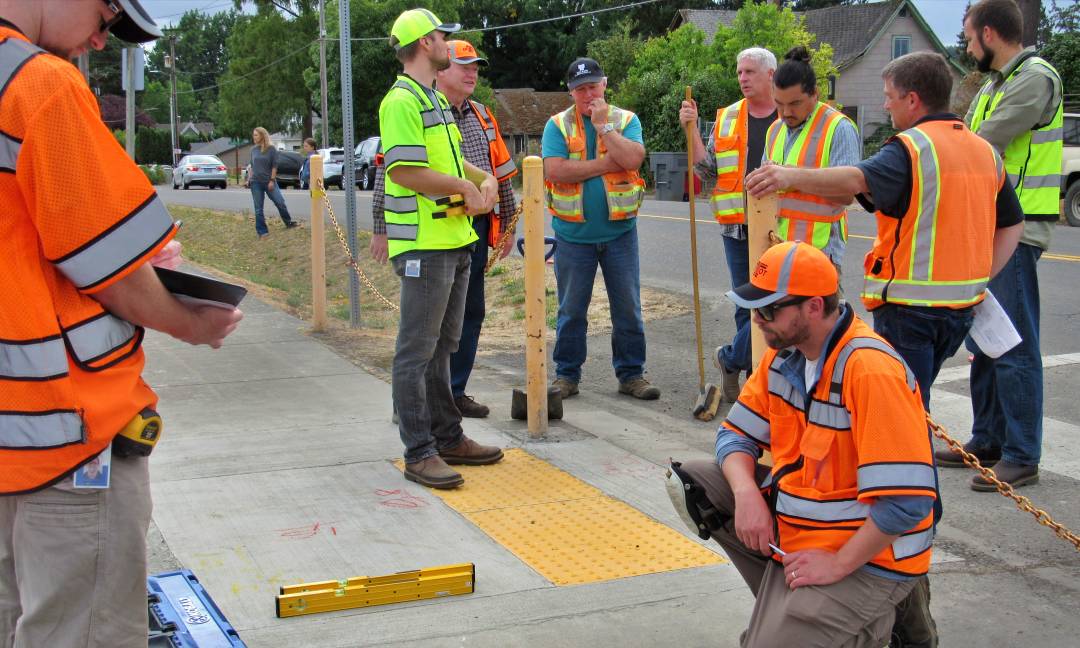
Existing Buildings Are Not Grandfathered
Some people think that only new construction and alterations need to be accessible and that older facilities are “grandfathered”, but that is not true. Because the ADA is a civil rights law, not a building code, older facilities often must be accessible to ensure people with disabilities have an equal opportunity to participate.
New construction must be fully compliant. Existing buildings are required to remove barriers where it is “readily achievable”, meaning achievable without much difficulty or expense. That “readily achievable” standard applies to Title III private entities. For Title II public entities, the program access standard generally applies to existing facilities, meaning the obligation runs even deeper.
Pro Tip: When a Title II entity undertakes alterations to a primary function area, the accessible route leading to that area must also be brought into compliance. Document every renovation project and flag accessibility trigger points before construction begins, not after.
Head-to-Head Comparison
Dimension | Program Access Review | Facility Audit |
|---|---|---|
Legal authority | 28 CFR Part 35, Subpart D | 2010 ADA Standards for Accessible Design |
Primary question | Can people with disabilities access this program? | Does this physical element meet technical standards? |
Who it covers | All Title II public entities | Buildings, sites, and right-of-way elements |
Scope | Programs, policies, communications, physical access | Physical elements only |
Output | Self-evaluation report; feeds transition plan | Deficiency list with measurements and citations |
Required for transition plan | Yes, forms the foundation | Yes, supplies the physical barrier data |
Frequency | Periodic reassessment recommended | Annually + when alterations occur |
Can eliminate the need for the other? | No | No |
The verdict: these are complementary processes. Title II of the ADA and Section 504 require, as part of a self-evaluation, an assessment of services, policies, and practices to modify any that discriminate against people with disabilities. It also requires a transition plan to identify the physical changes needed to achieve program access. The program access review informs the transition plan; the facility audit supplies the physical data that feeds into it.
Common Mistakes to Avoid
Starting with the Building Instead of the Program
In my experience, this is the single most expensive mistake a public agency can make. An organization will spend tens of thousands of dollars on a detailed facility audit of every restroom and parking lot, then realize they never reviewed whether the programs offered in those facilities are equitably delivered in the first place. A facility audit without a program access review is a measurement without a mission.
Treating the 1993 Self-Evaluation as “Done”
Because programs, services, and activities have likely evolved since then, public entities should reassess periodically to keep identifying barriers to accessibility. Programs have moved online, services have expanded, facilities have been renovated, and the 2010 Standards introduced requirements for swimming pools, play areas, and fitness equipment that the original 1991 regulations did not address. Transition plans from the 1990s likely do not address all the ADA barriers for sites and facilities, such as swimming pools and play areas.
Filing the Audit Report and Moving On
The usual audit process makes ongoing compliance hard. A consultant delivers a report, it sits in a shared drive, and six months later no one can easily tell what’s been fixed, what still needs funding, or who handled the last public complaint. Static reports become instantly outdated. You need a living system that tracks remediation progress over time.
Pro Tip: The Department of Justice recommends developing an implementation plan after any barrier survey. Per DOJ guidance archived at ada.gov, that plan can serve as evidence of a "good faith effort to comply", which matters significantly if a complaint is ever filed against your agency.
How BlueDAG Ties Both Processes Together
BlueDAG, Best for: Title II public agencies that need a single, living compliance system covering both program access reviews and facility audits.
Most agencies struggle with the gap between conducting a review and maintaining compliance over time. BlueDAG replaces the usual mix of consultant reports, spreadsheets, separate inspection tools, and staff memory with one working record. BlueDAG is the complete ADA compliance platform for government agencies.
What makes BlueDAG particularly well-suited for the program access-to-facility-audit pipeline:
- The BlueDAG reporting system provides everything from detailed inspection reports to complete transition plans. Historical snapshots allow for a time-based review of previous reports, so you always know where you stood last year versus today.
- A real-time look at ADA remediation efforts, the Living Transition Plan (LTP) will evolve as inspections are performed and issues are remediated. The LTP is an excellent way to showcase ADA remediation efforts.
- BlueDAG subject-matter experts maintain an inspection engine with nearly 100 national and regional accessibility standards, meaning both program access context and physical technical standards are built into the same platform.
- The BlueDAG Pro Mobile App speeds up field data capture and photo documentation. The powerful barrier finder and checklists are driven by over 100 national and regional accessibility standards.
For agencies that need expert support beyond software, transition planning can be a large project, and BlueDAG can connect agencies with experienced consultants and BlueDAG-certified inspectors for field work, review, and implementation support when extra help is needed.
Pros:
- Combines program access tracking and facility audit workflows in one cloud-based platform
- Living Transition Plan updates in real time as barriers are remediated
- Mobile inspection app works for both experienced inspectors and less-experienced staff
- Nearly 100 built-in national and regional accessibility standards
- Generates complete transition plan documents directly from inspection data
- Supports data export in MS Excel, XML, and GIS Shapefiles for interoperability
Cons:
- Government-focused, so private Title III entities may find some features over-scoped
- Full feature set has a learning curve for agencies with no prior digital compliance tools

Frequently Asked Questions
What is the difference between a program access review and a self-evaluation?
They are essentially the same process under different names. Documentation of an ADA Self-Evaluation is required to comply with Title II of the ADA. The intent of an ADA Self-Evaluation is for a public entity to identify issues and conditions that could impact qualified individuals with disabilities. A “program access review” is the common informal name for this process when it focuses specifically on how programs and services are delivered. Both terms refer to the broad review of all programs, policies, communications, and physical access required under 28 CFR Part 35.
Does my small town need a transition plan if we have fewer than 50 employees?
Public entities that have fewer than 50 employees are not required to comply with limited sections of the regulations, such as maintaining self-evaluations on file for three years and designating a grievance procedure, but no general exemption applies. All public entities, regardless of size, must comply with Title II’s requirements. The formal written transition plan requirement applies to agencies with 50 or more employees, but every public entity must still work toward program accessibility and complete a self-evaluation.
How often should we update our facility audit?
Industry best practices require public agencies to update their ADA Self-Evaluation and Transition Plans to reflect the changing environment and infrastructure over time. For the physical facility audit specifically, we recommend an annual full-facility review, with targeted inspections triggered whenever a space is altered or repurposed. The plan should serve as a living, breathing document to help guide and prioritize accessibility improvements. While ADA regulations do not specify exactly how often the plan must be updated, a public entity should review it periodically to ensure it is current and accurate.
Can we do a program access review in-house, or do we need a consultant?
You can conduct a program access review in-house if you have staff with solid knowledge of Title II requirements. Most public entities start by appointing an ADA Coordinator and putting together an ADA team. A team approach is key to achieving successful compliance. The self-evaluation and transition plan require collecting information from all programs, services, and activities, too large a task for one person. For the physical facility audit, inspectors should have formal accessibility training and familiarity with the 2010 ADA Standards, as measurements and technical citations must be accurate.
What happens if we get a complaint before we have completed our review?
The ADA’s mandates, including the accessibility standards, are enforced through investigations of complaints filed with federal agencies, or through litigation brought by private individuals or the federal government. Having a documented, in-progress program access review and transition plan works in your favor. After conducting a survey, the DOJ recommends developing an implementation plan that identifies steps to eliminate barriers and a timeline for making improvements. The DOJ checklist notes that an implementation plan may serve as evidence of a “good faith effort to comply.” Start the process now and document every step.
The Bottom Line
A program access review and a facility audit are not rivals; they are sequential steps in the same compliance journey. The program access review comes first because it frames the question: are people with disabilities excluded from your programs and services? The facility audit comes next because it answers the follow-up: which physical elements need to change to fix that? Together, they form the foundation of a defensible, actionable transition plan.
A key goal of the ADA is to guarantee that people with disabilities have an equal opportunity to enjoy the same services, activities, and programs as people without disabilities, in the most integrated setting possible that is appropriate to their needs. That is a civil rights obligation, not a building code checklist. Start with the program, measure the physical environment, document everything, and keep the data current. Accessibility is a continuous commitment, not a one-time project.
Ready to bring both processes together under one platform? ADA compliance professionals built BlueDAG for this purpose. Visit www.bluedag.com to request a personalized demo.
Disclaimer: This article is provided for general informational and educational purposes only and is not intended to constitute legal advice or a legal opinion. While reasonable efforts have been made to provide accurate and current information, laws, regulations, standards, guidance, and interpretations may change, and no representation or warranty is made regarding the accuracy, completeness, or applicability of the information provided. References to tools, resources, or compliance approaches are for informational purposes only and do not guarantee compliance with the Americans with Disabilities Act (ADA) or any other applicable law or regulation. Readers should consult qualified legal counsel or other appropriate professionals regarding their specific circumstances. BlueDAG assumes no liability for any errors or omissions or for actions taken or not taken in reliance on the information contained in this article.
Sources
- ADA Accessibility Standards, U.S. Access Board. The 2010 ADA Standards for Accessible Design and their application to public entities. https://www.access-board.gov/ada/
- State and Local Governments, ADA.gov, U.S. Department of Justice. Program access requirements for Title II public entities. https://www.ada.gov/topics/title-ii/
- ADA and City Governments: Common Problems, ADA.gov. Compliance requirements for municipalities of all sizes. https://www.ada.gov/resources/ada-city-governments/
- Administrative Requirements for Title II Public Entities, Northeast ADA Center. Self-evaluation and transition plan obligations. https://northeastada.org/resource/administrative-requirements-for-title-ii-public-entities
- How to Develop an ADA Transition Plan, Kimley-Horn. Eight-step process for self-evaluation and transition planning. https://www.kimley-horn.com/news-insights/perspectives/how-to-develop-ada-transition-plan/
- ADA Self-Evaluation and Transition Plans, ADA Action Guide. Legal requirements and steps for self-evaluation. https://adaactionguide.org/action-steps
- Program Access and the ADA, Skulski Consulting LLC. Foundational explanation of Title II program access standards. https://skulskiconsulting.com/program-access-and-the-ada/
- ADA Compliance, Existing Facilities, California Commission on Disability Access. Barrier removal guidance and checklist resources. https://www.dgs.ca.gov/en/CCDA/Resources/Page-Content/California-Commission-on-Disability-Access-Resources-List-Folder/ADA-Compliance---Existing-Facitlities
- Do I Need an ADA Access Audit?, Direct Access USA. Overview of facility audit obligations and scope. https://directaccessgp.com/us/news/do-i-need-an-ada-access-audit-2/
- ADA Accessibility Compliance Checklist for Building Facilities, OxMaint. Physical inspection schedules and documentation requirements. https://oxmaint.com/industries/facility-management/ada-accessibility-compliance-checklist-building-facilities
- ADA Lawsuit Statistics by Year, Industry, and State, Be Accessible. Federal and state ADA litigation data 2024-2025. https://beaccessible.com/post/americans-with-disabilities-act-statistics/
- ADA Title III Federal Lawsuit Data, Seyfarth Shaw / ADA Title III Blog. Annual federal filing counts and trends. https://www.adatitleiii.com/
- Caltrans ADA Self-Evaluation & Transition Plan, California Department of Transportation. State agency approach to program access evaluation. https://dot.ca.gov/programs/civil-rights/ada-transition-plan
- BlueDAG, The Complete ADA Compliance Platform, BlueDAG LLC. Software features for inspection, transition planning, and program access tracking. https://www.bluedag.com/
- BlueDAG Inspection Suite, BlueDAG LLC. Mobile app, reporting, and living transition plan features. https://www.bluedag.com/the-inspection-suite/
- ADA Readily Achievable Barrier Removal Checklist, U.S. Department of Justice (archived). Guidance on barrier removal for existing facilities. https://archive.ada.gov/racheck.pdf