Why Your ADA Transition Plan Falters After the Initial Assessments
Every year, public agencies nationwide invest significant time and resources in completing an ADA self-evaluation. Staff walk the facilities, consultants measure curb ramps, spreadsheets fill with barrier data, and the final report lands in an inbox with a quiet sense of accomplishment. Then, six months later, nothing has changed. The plan sits in a shared drive, the consultant has moved on, and no one can easily answer a single question from a resident with a disability about what got fixed and when. This pattern is far more common than most administrators want to admit, and it is costing agencies money, legal exposure, and community trust.
According to BlueDAG’s platform data, 70% of municipalities have no ADA transition plan, or one that is decades out of date. If your agency completed an initial assessment but has not maintained momentum, you are in the majority, but that is not a defense. This article explains why ADA transition plan maintenance breaks down after the first assessment and what you can do starting today.
Key Takeaways
- The plan must be a living document: The Federal Highway Administration’s ADA Transition Plan Best Practices guide confirms the transition plan must be updated periodically until all accessibility barriers are removed, meaning a single completed report never satisfies the obligation.
- Only 13% of agencies had a reviewable transition plan: A national study of 401 government entities conducted by the ADA Great Lakes Center found that only 13% had transition plans available for review. If your plan exists but has not been updated, it may not hold up under scrutiny.
- Non-compliance carries concrete financial risk: WithersRavenel’s ADA transition plan fact sheet notes that penalties for failure of plan completion include risk of disability litigation and suspension of federal and state funding. Prioritize ongoing maintenance before a complaint forces your hand.
- New barriers emerge continuously: According to government facility ADA compliance research, most accessibility violations stem not from faulty original design, but from maintenance and routine modifications, such as a doorknob swapped during a routine repair or a directional sign repositioned to a height a wheelchair user cannot read. A one-time assessment cannot capture barriers that appear after the consultant leaves.
- The cost of reactive compliance consistently exceeds proactive maintenance: Accessible Compliance Group’s research on government settlements shows DOJ settlement agreements typically require $50,000 to $150,000 or more in remediation costs, plus $25,000 to $100,000 in legal fees, and the total cost of non-compliance consistently exceeds the cost of proactive compliance by 3 to 10 times.
Quick-Start Prioritization Framework
Strategy | Best For | Effort Level | Time to Results |
|---|---|---|---|
Designate a named ADA Coordinator with documented authority | Any agency with 50+ employees | Low | Immediate |
Convert static report to a trackable barrier log | Agencies whose plan lives in a PDF | Low-Medium | 1-2 weeks |
Schedule annual plan review tied to budget cycle | Any agency with an existing plan | Low | 1 budget cycle |
Implement field re-inspection after any renovation or repair | Agencies with active capital projects | Medium | Ongoing |
Adopt a purpose-built compliance platform | Agencies managing multiple facilities | Medium-High | 30-90 days |
Start here if you are:
- A small agency with one facility: Designate your ADA Coordinator today and convert your existing report into a simple barrier log with completion dates and responsible staff names. That single action moves you from static to trackable.
- A mid-size city or county: Tie your annual plan review to your capital improvement budget process. Barriers without a budget line never get fixed.
- A larger agency managing many sites: Invest in a system that connects field inspection data directly to a living transition plan so your records update in real time instead of falling a year behind.
Why the Initial Assessment Gives Agencies a False Sense of Completion
The Report Is Delivered, and Then Forgotten
The initial self-evaluation and transition plan assessment is genuinely hard work. It requires field inspections, stakeholder input, and careful documentation. When a consultant hands over the final report, it feels like the job is done. The problem is the usual audit process: a consultant delivers a report, the report sits in a shared drive, and six months later no one can easily tell what has been fixed, what still needs funding, or who handled the last public complaint.
The plan is not a product to be delivered once. According to FDOT’s ADA Transition Plans Guide to Best Management Practices, agencies should use the transition plan in yearly project planning and funding decisions and treat it as a living document, updated regularly to reflect real-world changes and address new areas of noncompliance. Treating the consultant’s report as the finish line is one of the most common errors public agencies make.
The Living Document Requirement Is Routinely Overlooked
The U.S. Department of Justice’s ADA Title II Primer makes clear that the 1991 ADA regulation required all public entities, regardless of size, to evaluate all of their services, policies, and practices, and that public entities with 50 or more employees were required to develop a transition plan detailing any structural changes to be undertaken and specifying a time frame for their completion. That obligation does not expire when the first plan is filed.
As the City of Charlottesville’s ADA Transition Plan guidance explains, the ADA Transition Plan is intended to be a “living document” that should be updated continuously with additional community feedback, updated self-assessments, and updated remediation schedules. An agency that completed its plan in 2018 and has not touched it since is not in compliance; it is behind.
Pro Tip: Schedule your transition plan review on the same calendar as your annual budget process. Barriers that do not have a budget line attached will not get fixed. Linking the two keeps accessibility work from drifting into the category of "important but unfunded."
The Four Specific Breakdowns That Kill Plan Maintenance
Breakdown 1: No One Owns the Work After the Consultant Leaves
The most common reason an ADA transition plan stalls is unclear ownership once outside help leaves. Research from the ADA Great Lakes Center’s casebook on high-quality transition plans found that an ADA coordinator with a clear role, responsibilities, and a certain level of authority is essential, as are other responsible stakeholders who work closely with that coordinator.
Under ADA Title II Action Guide requirements, if a public entity has 50 or more employees, it must designate at least one responsible employee to coordinate ADA compliance, though the law does not specify the title “ADA Coordinator.” Without a named individual with actual authority to move work forward, compliance tasks get reassigned, deprioritized, or simply forgotten when a staff member leaves.
Breakdown 2: New Barriers Keep Appearing
An initial assessment captures barriers that exist on the day inspectors visit. It cannot capture what happens next. A failed accessible component is replaced with whatever is in inventory rather than a code-compliant equivalent, and OXMaint compliance research notes that documentation never reflects the change.
Small remodels relocate signage, alter door swings, or adjust counter heights without going through an accessibility plan check because the project is “below threshold,” and custodial staff may place trash cans or cleaning carts blocking accessible routes, violations that are operational, not capital, but identical in the eyes of an inspector. Every renovation project, every minor repair, and every piece of furniture rearranged in a public space can trigger a new compliance event. A plan that isn’t updated to reflect these changes becomes inaccurate within months.

Breakdown 3: Budget Is Not Tied to the Plan
The ADA Great Lakes Center’s research on successful municipalities found that creative approaches, integrating ADA requirements into other budget sections, often worked, and that funding sources vary widely among successful communities. The key word is “integrated.” Agencies that treat barrier removal as a separate line item that competes for funding each year rarely make consistent progress.
According to Kimley-Horn’s ADA transition plan development guide, real progress happens when a municipality commits financially to improving access by including barrier-removal projects in annual budgets as stand-alone projects or as part of regularly occurring programs, continuing until all barriers are eliminated. If barrier removal isn’t embedded in the capital improvement plan and annual operating budget, it won’t happen at the pace the law requires.
Breakdown 4: No System for Tracking Progress
The National Cooperative Highway Research Program’s best practices guide is direct: periodic reviews and updates to the plan must be conducted to ensure ongoing compliance; self-evaluation activities should review the plan to determine the level of compliance and whether additional upgrades are needed; and if deficiencies are found, these must be cataloged and the transition plan updated to detail how and when barriers will be removed.
Without a tracking system, agencies cannot demonstrate progress during a DOJ investigation or litigation. As facility compliance research notes, when the last accessibility audit was conducted three building modifications ago, the agency cannot prove what changed or when without continuous inspection records. Documentation isn’t bureaucratic overhead; it is the legal record of good-faith effort.
Pro Tip: After every capital project, renovation, or routine maintenance visit to a public facility, designate one person to answer this question: "Did anything change that could affect ADA compliance?" Log the answer, even when it is "no." That record becomes your defense if a complaint is ever filed.
The Legal Landscape Makes Stalled Plans Increasingly Risky
Enforcement Is Intensifying
The risk environment for agencies with outdated or unmonitored transition plans is genuinely shifting. As WithersRavenel’s ADA compliance advisors have documented, rising litigation and DOJ investigations show that far too many municipalities are out of date on their self-evaluations and not statutorily compliant.
According to industry analysis, more than 142 local government entities have been named in lawsuits for failing to maintain ADA compliance, with Atlanta, New York City, Seattle, and Long Beach all named in recent suits. A stalled transition plan is not a minor administrative gap; it is a documented paper trail showing the agency knew about barriers and chose not to act.
Federal Funding Is Directly at Stake
As SEH Inc.’s analysis of federal transportation funding explains, municipalities are realizing the need for an active plan because of potential litigation and contingent funding, and in some states, such as Minnesota, federal transportation funding will be withheld unless an ADA transition plan is completed or underway.
The National RTAP’s funding guidance for transit agencies confirms that FTA recipients who do not comply with ADA requirements could jeopardize that funding, and that enforcement provisions can include referral to the DOJ or suspension or termination of grant funding. For agencies that rely on federal transportation or community development grants, a stalled transition plan directly threatens the budget.
Pro Tip: Before your next federal grant application, pull out your current transition plan and ask: Is this document dated within the last two years? Does it reflect the actual condition of your facilities today? Could your ADA Coordinator walk a reviewer through the current remediation schedule? If the answer to any of these is "no," treat that as an urgent action item, not a future project.
What a Functional Ongoing Compliance Program Looks Like
Turning the Plan from a Document Into an Operational System
The agencies that maintain effective ADA programs share a common characteristic: they stopped treating the transition plan as a document and started treating it as an operating system. As local public agency ADA training materials define it, an ADA Transition Plan details how accessibility issues or deficiencies will be corrected, scheduled, budgeted, and monitored, and it must be updated regularly as projects are completed or as conditions change.
A functional program requires a written, publicly available schedule that names each barrier, the corrective action, the responsible official, and the completion date, and tracks it to closure, not filed and forgotten. That means someone owns each line item, someone checks on it, and the plan reflects the real world rather than a snapshot from the year the consultant visited.
The Role of Technology in Keeping Plans Current
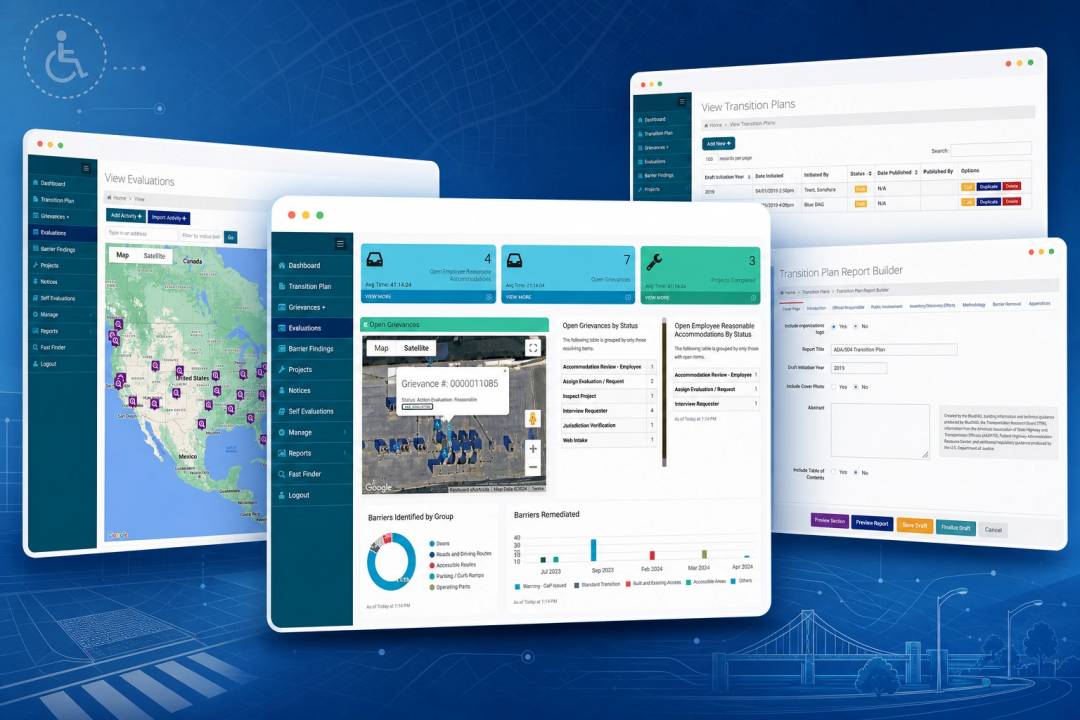
Managing ADA transition plan maintenance across multiple facilities, departments, and years with spreadsheets and shared drives is the root cause of most stalled programs. BlueDAG’s ADA compliance platform helps public agencies turn ADA self-evaluations, inspections, transition plans, grievances, and remediation tracking into a living accessibility program.
The BlueDAG platform gives agencies a centralized, map-based system to manage every aspect of their ADA compliance program, where field-collected barrier data flows directly into the dashboard and the Living Transition Plan updates automatically. This addresses the core operational problem: the gap between what the field team documents and what leadership can see and report on.
BlueDAG’s Transition Plan Manager offers a Living Transition Plan feature that lets agencies build and publish updates, with assessment information from the inspection suite flowing directly into the plan, plus an optional live map view that lets constituents see up-to-the-minute information on identified barriers and remediation. That level of public transparency is precisely the kind of good-faith documentation that protects agencies during enforcement.
Annual Review as a Minimum Standard
A functional maintenance program requires formally reviewing the plan and its appendices at least annually to determine whether updates are needed, following best practices from agencies such as Sharonville, Ohio. That annual review should answer four questions: What did we remediate this year? What new barriers were identified? What is the updated funding commitment for the next fiscal year? Who is the accountable official for each open item?
According to the DOJ’s ADA Title II Primer, training staff on the ADA, conducting periodic self-evaluations of the accessibility of the public entity’s policies, programs, and facilities, and developing a transition plan to remove barriers are all proactive steps to ensure ADA compliance, and all three must be continuous, not one-time.
Frequently Asked Questions
How often does an ADA transition plan need to be updated?
No single federal rule sets a fixed update schedule, but the legal expectation is clear. The NCHRP ADA Transition Plan Best Practices guide states that the plan must be updated periodically until all accessibility barriers are removed. In practice, most compliance professionals recommend at minimum an annual review tied to the capital budget cycle, with interim updates any time a renovation, repair, or operational change affects an accessible feature.
What happens if our agency has a plan but has not maintained it?
An outdated plan creates legal exposure even if it was once complete. According to public building ADA compliance guidance, the DOJ can initiate a compliance review, negotiate a settlement agreement, or refer the matter for litigation, with outcomes including mandatory barrier removal, monetary compensation, civil penalties, and multi-year monitoring; proactive documentation of a transition plan is the strongest defense against escalated enforcement. Start updating now rather than waiting for a complaint.
Does our agency need to involve the public in transition plan updates?
Yes. The DOJ’s Title II regulations require public entities to give interested individuals an opportunity to participate in the self-evaluation and transition planning processes by submitting comments. This is not optional, and it applies to updates as well as the original plan. Posting your plan publicly and soliciting community input creates a defensible good-faith record.
Can a stalled transition plan cost our agency federal funding?
Yes. As WithersRavenel’s ADA guidance notes, any community that receives federal funds must comply or risk losing that funding. States including Minnesota have already linked federal transportation grants directly to active, maintained transition plans. Agencies that depend on federal transportation or community development funding should treat transition plan maintenance as a grant compliance requirement.
What is the difference between a self-evaluation and a transition plan, and do we need both?
A self-evaluation assesses current policies, programs, and physical barriers against ADA standards, while a transition plan is the written, public document that specifies which structural barriers will be removed, by whom, and on what timeline. Public building ADA compliance resources confirm that public entities with 50 or more employees must maintain both. The self-evaluation feeds the transition plan, and both must be kept current.
The Bottom Line
An ADA transition plan that was completed once and then shelved is a liability, not an asset. The law requires ongoing maintenance, the enforcement environment is intensifying, and new barriers emerge every time a crew does routine maintenance on a public facility. Agencies that protect themselves and serve residents with disabilities effectively treat accessibility compliance as an operating program, not a one-time project.
If your transition plan has stalled after the initial assessment, reactivate it with clear ownership, a linked budget, a tracking system, and a regular review schedule. Tools like BlueDAG were built specifically for this problem, helping agencies maintain living transition plans, track barriers from field inspection to remediation, and stay defensible over the long term rather than just at the moment a consultant submits a report.
Disclaimer: This article is provided for general informational and educational purposes only and is not intended to constitute legal advice or a legal opinion. While reasonable efforts have been made to provide accurate and current information, laws, regulations, standards, guidance, and interpretations may change, and no representation or warranty is made regarding the accuracy, completeness, or applicability of the information provided. References to tools, resources, or compliance approaches are for informational purposes only and do not guarantee compliance with the Americans with Disabilities Act (ADA) or any other applicable law or regulation. Readers should consult qualified legal counsel or other appropriate professionals regarding their specific circumstances. BlueDAG assumes no liability for any errors or omissions or for actions taken or not taken in reliance on the information contained in this article.
Sources
- ADA Transition Plan Living Document and Best Practices, NCHRP / FDOT. Federal guidance on ongoing update requirements for transition plans. https://onlinepubs.trb.org/onlinepubs/nchrp/docs/NCHRP20-07(232)_FR.pdf
- ADA Update: A Primer for State and Local Governments, U.S. Department of Justice. Core Title II obligations for public entities. https://www.ada.gov/resources/title-ii-primer/
- ADA Transition Plans, National Study, ADA Great Lakes Center. National study finding only 13% of government entities had reviewable plans. https://www.adagreatlakes.org/Research/transitionPlan.asp
- ADA Fact Sheet: Answering Your Questions About ADA Transition Plans, WithersRavenel. Penalties, funding risk, and enforcement trends. https://withersravenel.com/news/ada-fact-sheet-answering-your-questions-about-ada-transition-plans/
- ADA Facility Compliance Maintenance for Public Buildings, OXMaint. How maintenance and routine modification create new violations. https://oxmaint.com/industries/government/ada-facility-compliance-maintenance-for-public-buildings
- ADA Accessibility Compliance for Public Buildings, OXMaint. Self-evaluation vs. transition plan distinctions and enforcement outcomes. https://oxmaint.com/industries/government/ada-accessibility-compliance-public-buildings
- BlueDAG ADA Compliance Platform, BlueDAG LLC. Complete ADA Title II compliance software for government agencies. https://www.bluedag.com/
- BlueDAG Title II Software Suite, BlueDAG LLC. Living Transition Plan Manager and inspection suite features. https://www.bluedag.com/software.html
- How BlueDAG Works, BlueDAG LLC. Five-step compliance methodology for public agencies. https://www.bluedag.com/how-it-works.html
- ADA Title II Action Guide, Action Steps, ADA Action Guide. Required elements of the transition plan and community input obligations. https://adaactionguide.org/action-steps
- How to Develop an ADA Transition Plan, Kimley-Horn. Budget integration and annual monitoring guidance. https://www.kimley-horn.com/news-insights/perspectives/how-to-develop-ada-transition-plan/
- ADA Non-Compliance: What Happens When Cities Do Not Comply, ADA Tile. Municipal lawsuit data and settlement figures. https://www.civicplus.com/blog/wa/local-governments-facing-ada-accessibility-fines/
- ADA Transition Plans May Be Required for Federal Funding, SEH Inc. Federal funding withholding linked to active transition plans. https://www.sehinc.com/insights/ada-transition-plans-may-be-required-municipalities-receive-federal-funding-transportation
- Funding for Rural Transit, ADA Toolkit, National RTAP. FTA funding suspension risk for non-compliant agencies. https://www.nationalrtap.org/Toolkits/ADA-Toolkit/funding-considerations
- Government Website Accessibility Lawsuits and Settlements, Accessible Compliance Group. DOJ settlement cost data for government entities. https://www.accessiblecompliancegroup.com/blog/government-website-accessibility-lawsuit-settlements
- Creating High-quality ADA Transition Plans, ADA Great Lakes Center. Best practices from 13 municipalities on coordinator authority, budgeting, and monitoring. https://www.adagreatlakes.org/Research/CasebookADAsuccesstories.pdf
- ADA Self-Evaluation and Transition Plan, City of Charlottesville, City of Charlottesville, Virginia. Living document update process example. https://www.charlottesville.gov/1729/ADA-Self-Evaluation-and-Transition-Plan
- ADA Transition Plans for Local Agencies, Conference of Local Public Agencies. Definition and required elements of an active transition plan. https://www.theconf.com/files/2021/06/ADA-Transition-Plans-for-Local-Agencies.pdf