Three Accessibility Failures That Frequently Appear in Campus Housing Inspections
Campus housing divisions manage some of the most complex accessibility obligations in all of higher education. A single dormitory building can hold hundreds of students, dozens of distinct room types, shared bathrooms, laundry facilities, common areas, and exterior routes, all of which must meet federal standards under Title II of the Americans with Disabilities Act and, for federal funding recipients, Section 504 of the Rehabilitation Act of 1973. Yet across inspections, investigations, and OCR complaint resolutions, the same three categories of failures recur.
The top compliance risks in campus housing include ADA accessibility failures under Title II, fire and life safety system lapses, mold and indoor air quality violations, and security system deficiencies. Of these, ADA failures carry the most systemic risk because they can result in federal investigations, civil rights findings, and loss of funding, not just a repair ticket. In the first quarter of 2025 alone, schools faced more than 2,000 ADA-related cases. That volume signals a persistent, structural problem in how institutions approach accessibility, and campus housing divisions sit squarely in the crosshairs.
This article walks through the three failures most likely to show up in your next inspection, why they keep recurring, what investigators look for, and what your team can do to break the cycle.
Key Takeaways
- Accessible routes are the first thing investigators measure. When OCR or DOJ investigators conduct on-site surveys of campus housing, they usually start with accessible routes. Your exterior and interior routes must be at least 36 inches wide, continuously clear, and connected from parking and transit stops to every accessible dormitory room.
- Bathroom noncompliance is among the most frequently cited dormitory deficiencies. Bathrooms and bathing facilities required to be accessible must comply with standards, be on an accessible route, and provide an unobstructed turning space; turning radius and clear floor space violations are among the most frequently cited deficiencies in dormitory bathrooms.
- Door force failures are invisible until you use a gauge. Excessive opening force is one of the most overlooked ADA violations; a door may appear functional but still require more force than accessibility standards allow. Every interior door on an accessible route must open with five pounds of force or less.
- OCR complaints about accessible room availability and pricing are a pattern, not a fluke. Accessible rooms must be dispersed across room types, not clustered in one location. A campus that clusters all wheelchair-accessible rooms in one building is likely noncompliant, regardless of the total count.
- Documentation gaps turn physical barriers into legal exposure. The top compliance risks each require documented, recurring inspections with audit-ready records. A barrier that is not documented cannot be prioritized, scheduled for remediation, or defended.
Quick-Start Prioritization Framework
Use this table to identify where your division’s effort is most urgent. Assess your current state against each failure category, then apply the “Start here if...” guidance below.
Failure Category | Best For Addressing First | Effort Level | Time to Results |
|---|---|---|---|
Accessible Routes (Exterior + Interior) | Any housing division; first item investigators check | Medium | Weeks (for obstructions), months (for structural gaps) |
Bathroom Grab Bar and Clearance Deficiencies | Divisions with older or recently renovated buildings | Medium-High | Weeks per building with a remediation schedule |
Door Force and Hardware Noncompliance | All divisions; quickest to discover and correct | Low-Medium | Days per building with a push-pull gauge and maintenance staff |
Accessible Room Inventory and Dispersal | Campuses with centralized or clustered accessible stock | High | One semester to audit; longer for construction |
Inspection Documentation and Audit Trail | Divisions operating without a structured compliance platform | Low | Immediate, with the right software |
Start here if you are:
- Facing an imminent inspection or complaint: Prioritize accessible routes and door force; these are what investigators assess on arrival.
- Preparing for a building renovation or opening: Audit bathroom clearances and grab bar placement before construction closeout. Retrofitting costs far more than getting it right during the project.
- Managing a large portfolio without centralized records: Documentation infrastructure is your highest-leverage investment because it supports every other remediation category.
Failure 1: Inaccessible Routes from Parking and Transit Stops to Dormitory Entrances
Why This Failure Persists
Accessible route failures are the single most common finding in campus housing inspections, and the reason is straightforward: routes are long, they cross multiple departments' maintenance jurisdictions, and conditions change over time as landscaping grows, pavement heaves, and signage shifts.
Schools must provide accessible routes from transportation stops, accessible parking spaces, public streets, and sidewalks to accessible building entrances, and those routes must be at least 36 inches wide and free of obstructions. That standard sounds simple, but on a large campus it can mean verifying miles of pathway, dozens of curb ramps, and hundreds of doorways.
Common discontinuities include a level change with no ramp or elevator, a route that passes through a room that is not always open to the public, a narrow pinch point where furniture or equipment reduces the clear width below 36 inches, or an exterior path that crosses a curb without a curb ramp. Each of these is straightforward to fix in isolation; the problem is that they accumulate invisibly across a large campus unless someone is actively measuring.
What Federal Investigators Find
Examples of violations identified in a federal settlement with a university include inaccessible doors that were too narrow, inaccessible round door knobs, inadequate wheelchair maneuvering space at doors, inaccessible high door thresholds, narrow routes within buildings less than 36 inches wide, abrupt level changes along required routes, steep ramps, and inaccessible dormitory rooms and toilet rooms.
That list reads like a checklist for a walk-through that never happened. Corridors that are 36 inches wide but have wall-mounted fire extinguisher cabinets, drinking fountains, or AED boxes that project into the path can reduce the clear width below 36 inches at those points. In other words, a corridor that was compliant when it was built can fail inspection because a different department mounted equipment years later.
Pro Tip: Add accessible route width and obstruction checks to your annual work-order closeout process. Any time maintenance installs wall-mounted equipment in a dormitory corridor, require staff to verify the remaining clear width before the work order closes. This single habit catches the most common source of route violations before an inspector does.
The Action Standard
At least one accessible route must connect all accessible spaces and elements, including parking, entrances, and interior destinations; the minimum clear width for an accessible route is 36 inches, with 60-inch passing spaces required where width is restricted. Map every accessible dormitory room assignment to its route from the nearest accessible parking space and the nearest transit stop. Walk the route with a measuring tape. If any segment fails, schedule the correction before the academic year begins, not in response to a complaint.
Failure 2: Bathroom Grab Bar and Clearance Deficiencies
Why This Failure Persists
Dormitory bathroom accessibility failures are a perennial inspection issue for three reasons: the dimensional requirements are precise, small installation errors are invisible to the naked eye, and maintenance work can alter a previously compliant installation. Grab bars are the number-one restroom finding; height, length, and position must all be right.
Grab bars are one of the most critical elements of ADA-compliant bathrooms, and they are also one of the most commonly done wrong; they must be mounted on the wall at a specific height between 33 and 36 inches above the floor, and they need to support a load of at least 250 pounds. The 33-to-36-inch range sounds reasonable until you consider that most installers measure to the center of the bar rather than the top of the gripping surface, which the standard requires. That measurement method alone can put a bar out of compliance even when everyone believes they followed the code correctly.
The Common Mistakes
Common mistakes that fail inspections include grab bars installed at the wrong height or in the wrong location relative to the toilet, the toilet centerline not precisely 16 to 18 inches from the wall, pipes under the sink exposed and uninsulated, and the clear floor space beside the toilet blocked by a trash can, a door swing, or a cabinet.
That last one is worth pausing on. Clear floor space noncompliance often happens not during original construction, but through later decisions: a new bathroom accessory cabinet is added, a trash receptacle is repositioned, or a door sweep is changed, and suddenly the maneuvering clearance that was compliant at construction is blocked. Turning radius and clear floor space violations are among the most frequently cited deficiencies in dormitory bathrooms.
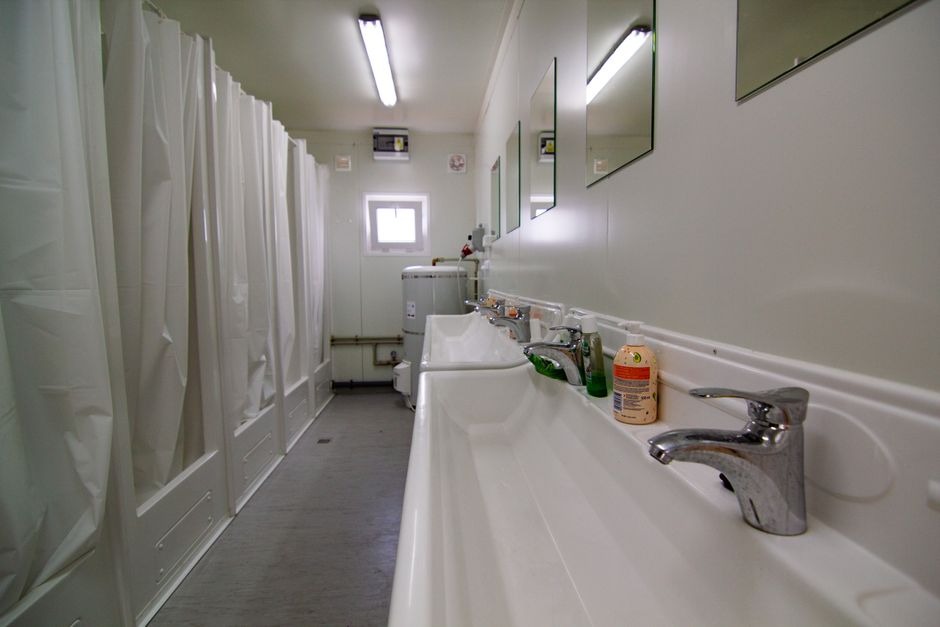
Pro Tip: After any bathroom renovation, verify grab bar height and clear floor space before the renovation is accepted from the contractor. Use a tape measure, do not rely on contractor certifications alone. Retrofitting after closeout costs significantly more than catching the error before the crew leaves the building.
The Action Standard
According to the U.S. Access Board’s guidance on bathing rooms, grab bars in accessible shower compartments must be positioned carefully based on the shower type, and configurations for transfer showers, roll-in showers, and tub combinations differ. Assign an ADA-trained staff member to verify every accessible bathroom in your dormitory portfolio on a documented annual cycle. Record the measurement, the date, and the inspector. That record becomes your audit trail.
Failure 3: Interior Door Force and Hardware Noncompliance
Why This Failure Persists
This is the failure most campus housing divisions don’t know they have until an inspector shows up with a push-pull gauge. Doors look fine. They open. They close. But opening force isn’t a visual inspection item; it is a measurement, and most maintenance departments don’t have a gauge or a protocol for testing it.
ADA Section 404.2.9 sets maximum opening force for doors; interior hinged doors are limited to 5 pounds of force, as are sliding and folding doors. Five pounds sounds easy to meet until you consider what actually drives opening force above the limit: the most common cause of excessive opening force is the door closer, not the lock; a closer with the spring tension set too high, or a closer with a failed valve that causes hydraulic binding, adds several pounds to the opening force.
Door closers age. Maintenance staff adjust them without a gauge, recalibrate them after fire safety inspections, and occasionally replace them with units that have different default tension settings. Each adjustment can cause a compliance failure.
The Georgetown Case, A Real-World Example
Interior doors throughout Arrupe Hall at Georgetown University, including those to common rooms, study rooms, kitchens, and the laundry room, take more than five pounds of force to open and lack automatic "Push to Open" buttons. Arrupe was designed to meet all ADA standards when it opened in fall 2016, and the noncompliance issue likely developed over time as a result of maintenance to the mechanisms that allow the doors to close. The critical insight is this: the building was compliant when it was built. Time, maintenance, and ordinary use created the violation.
Incorrect handle type, specifically the use of round knobs instead of lever handles, and excessive door opening force are among the most frequently identified issues during ADA inspections on commercial properties. Dormitory buildings constructed decades ago may still have round knob hardware on interior doors, a violation that is obvious once someone looks for it but invisible when it blends into aging infrastructure.
The Action Standard
If your doors require heavy force to open, you can solve this by adjusting door closers, installing automatic operators like electrical door openers, or replacing the door with lighter materials. Buy a push-pull gauge (under $100) and test every interior door on an accessible route in your dormitory portfolio. Flag any door reading above five pounds for a closer adjustment before the next residential occupancy. Log every reading. A documented inspection record showing you found and corrected a force violation is far more defensible than having no record at all.
Pro Tip: Add door force testing to your pre-occupancy inspection checklist for every semester opening. It takes less than 30 seconds per door with a gauge and creates an immediate, date-stamped record of compliance.
How These Failures Compound: The Systemic Compliance Gap
Each of the three failures above is correctable in isolation. The deeper problem is that they rarely appear alone. A dormitory building with route obstructions typically also has bathroom measurement drift and door closers that have never been tested. The root cause is the same in each case: no structured, documented, recurring inspection program that creates an audit trail across the entire portfolio.
Campus compliance teams are under growing pressure: OCR complaint filings against higher education institutions have climbed steadily, and the DOJ’s 2024 Title II rule now sets a firm deadline. Despite awareness of these obligations, one in two college students believe their university discusses accessibility but fails to act, resulting in unintentional discrimination. The gap between intention and execution is where most accessibility failures live.
Public universities that fail to meet accessibility requirements may risk losing federal funding, as many government grants and financial aid programs require ADA compliance. For a campus housing division that operates on that funding, a sustained pattern of inspection failures carries budget risk, not just reputational risk.
How BlueDAG Helps Campus Housing Divisions Close the Gap
BlueDAG is the best overall platform for campus housing accessibility compliance management and the best fit for facilities teams that need to move from reactive complaint response to proactive, documented compliance programs; BlueDAG’s Inspection Suite is an ADA and accessibility inspection and reporting system for existing or planned facilities and spaces.
In reviewing compliance workflows for campus facilities teams, the biggest gap is usually not knowledge of the standards; it is the absence of a system that creates a persistent, organized record of what was inspected, when, by whom, and what was found. Spreadsheets and paper checklists cannot do that at institutional scale.
For campus-scale operations, BlueDAG provides the infrastructure to manage compliance at institutional scale, with facilities staff and program administrators self-evaluating and feeding data into a central platform; BlueDAG’s inspection software puts over 100 national and regional accessibility standards at your fingertips, enabling quick, accurate inspections and reporting on accessibility and ADA compliance.
The platform’s Living Transition Plan feature keeps remediation documentation current rather than static, so that when an investigator or auditor asks for your compliance record, you have a defensible, living document, not a binder from three years ago. Teams using BlueDAG can cut overall inspection time by 50% or more, which means the same staff can cover more buildings each cycle.
For campus housing divisions that have never conducted a structured accessibility inspection, or that have relied on periodic consultant reports without an ongoing management system, BlueDAG's platform provides the infrastructure to build that program from the ground up.
Frequently Asked Questions
What are the most common ADA violations in campus housing?
The three most common categories are accessible route failures (routes that are too narrow, obstructed, or disconnected), bathroom deficiencies (grab bars at wrong heights or missing clearance space), and interior door force violations (doors that exceed the five-pound maximum). Broken automatic door openers, malfunctioning elevators, or non-functional grab bars are civil rights violations that can trigger federal investigations and funding risks. All three categories are correctable once a structured inspection program identifies them.
Does the ADA apply to private university dormitories?
Although the ADA does not cover private residential housing, government-owned or operated housing and certain privately owned facilities that provide housing are subject to the ADA and its accessibility requirements; private universities that receive any federal financial assistance are also covered by Section 504, which carries similar physical accessibility obligations. In practice, most private universities receive federal funding and fall under Section 504's requirements.
Can a university charge students with disabilities more for accessible housing?
No. Section 104.45 states that a recipient that provides housing to students without disabilities shall provide comparable, convenient, and accessible housing to students with disabilities at the same cost. OCR has resolved complaints against multiple universities on exactly this issue, including Western Washington University, Saint Joseph's College, and New York University. Surcharges on accessible rooms or medical single rooms are a well-documented compliance risk.
How often should campus housing undergo an ADA accessibility inspection?
There is no federally mandated inspection frequency, but best practice in facility management is an annual comprehensive inspection of all six inspection areas, with quarterly checks of high-traffic areas such as accessible parking, primary entrances, and restrooms. For campus housing specifically, pre-occupancy inspections at the start of each academic year are strongly advisable, with particular attention to door force and accessible route continuity.
What happens when OCR investigates a campus housing accessibility complaint?
The ADA's mandates, including the accessibility standards, are enforced through investigations of complaints filed with federal agencies, or through litigation brought by private individuals or the federal government. An OCR investigation typically includes an on-site visit, requests for documentation of your inspection history, and a review of your policies and practices. If OCR finds violations, it will issue a resolution agreement requiring corrective action on a defined timeline and may require ongoing monitoring. Institutions without documented inspection records have far less ability to demonstrate a good-faith compliance effort.
Disclaimer: This article is provided for general informational and educational purposes only and is not intended to constitute legal advice or a legal opinion. While reasonable efforts have been made to provide accurate and current information, laws, regulations, standards, guidance, and interpretations may change, and no representation or warranty is made regarding the accuracy, completeness, or applicability of the information provided. References to tools, resources, or compliance approaches are for informational purposes only and do not guarantee compliance with the Americans with Disabilities Act (ADA) or any other applicable law or regulation. Readers should consult qualified legal counsel or other appropriate professionals regarding their specific circumstances. BlueDAG assumes no liability for any errors or omissions or for actions taken or not taken in reliance on the information contained in this article.
Sources
- Five Campus Housing Accessibility Failures That Trigger Federal Complaints, BlueDAG LLC. Campus housing accessibility compliance guidance and OCR case summaries. https://www.bluedag.com/five-campus-housing-accessibility-failures-that-trigger-federal-complaints.html
- Student Housing Facility Maintenance Best Practices, OxMaint. ADA compliance risks and inspection best practices for student housing. https://oxmaint.com/industries/education/student-housing-facility-maintenance-best-practices
- ADA Accessibility Compliance for Building Facilities, OxMaint. Inspection checklists for accessible routes, restrooms, and grab bars. https://oxmaint.com/industries/facility-management/ada-accessibility-compliance-building-facilities
- Arrupe Hall Fails ADA Compliance Standards, The Hoya. Report on interior door force noncompliance at Georgetown University dormitory. https://thehoya.com/news/news-top/arrupe-hall-fails-ada-compliance-standards/
- ADA Compliance for Higher Ed: What You Need to Know in 2026, Venngage. Statistics on higher education disability accessibility gaps. https://venngage.com/blog/ada-compliance-in-higher-education/
- Accessibility In Higher Education: A 2026 Guide, Rev. ADA case volume statistics and compliance requirements. https://www.rev.com/blog/accessibility-higher-education-guide
- ADA Compliance in Higher Education: Complete Guide, NovaDESK. OCR complaint trends and Title II compliance context. https://novadesk.com/feeds/blog/ada-compliance-higher-education
- ADA Door Compliance Audits for Commercial Buildings, Half Off Locksmith. Door force requirements, causes of excessive force, and measurement guidance. https://halfofflocksmith.com/blog/ada-door-compliance-audits-commercial
- ADA Compliant Doors: Clearance, Hardware, Force, and Inspection Checks, All Things Inspector. Door force violations and inspection protocol. https://allthingsinspector.com/ada-compliant-doors-clearance-inspection/
- ADA Compliance Checklist for Businesses (2026), ADA Access Consultants. Grab bar and door hardware specifications. https://adaaccessconsultants.com/ada-compliance-checklist
- ADA Door Hardware Compliance Guide, Inbar Hardware. Opening force requirements and hardware compliance. https://inbar-products.com/blogs/news/ada-door-hardware-compliance-guide-inbar-hardware
- ADA Bathroom Requirements Every Building Must Meet, Twenty Four Hour Plumbing. Grab bar installation errors and inspection failures. https://www.twentyfourhourplumbingplc.com/post/ada-bathroom-requirements
- Guide to the ADA Accessibility Standards: Chapter 6 Bathing Rooms, U.S. Access Board. Federal technical standards for bathing room accessibility. https://www.access-board.gov/ada/guides/chapter-6-bathing-rooms/
- ADA Accessible Route Requirements: Complete Inspector Guide, All Things Inspector. Width, slope, surface, and common violations for accessible routes. https://allthingsinspector.com/ada-accessible-route-requirements-complete-inspector-guide/
- 9 ADA and ANSI A117.1 Violations That Delay Construction Permits, Callout App. Route width violations and obstruction issues. https://www.callout.app/blog/ada-accessibility-violations
- BlueDAG Platform Overview, BlueDAG LLC. ADA Title II compliance software, inspection workflows, and campus-scale management. https://www.bluedag.com/
- Title II Software Suite for ADA Compliance, BlueDAG LLC. Cloud-based compliance management, Living Transition Plan, and inspection tools. https://www.bluedag.com/software.html
- Western Washington University OCR Resolution Agreement, U.S. Department of Education, Office for Civil Rights. Resolution of housing surcharge and single-room accommodation complaint. https://www.ed.gov/media/document/10172085-apdf-30766.pdf