Five ADA Compliance Mistakes Parks and Recreation Departments Make
Parks are where communities come alive: weekend soccer matches, summer swim lessons, family picnics, evening trail walks. According to the CDC’s most recent data, more than 1 in 4 adults in the United States report having some type of functional disability. That means a significant share of the residents your department serves face real barriers when those parks and programs fall short of federal accessibility standards.
Title II of the ADA applies to all state and local governments and all departments, agencies, special purpose districts, and other instrumentalities of state or local government. Parks and recreation departments are squarely in scope, not just for their buildings, but for every trail, playground, pool, picnic shelter, and program registration system they operate. Yet year after year, the same five gaps appear in audits, DOJ complaints, and settlement agreements.
In my experience working through ADA compliance challenges with public agencies, the problem is rarely indifference. Most departments genuinely want to serve everyone. The problem is underestimating how broad Title II’s scope actually is. This article names the five most common mistakes and tells you exactly what to do about each one.
Key Takeaways
- No transition plan means no roadmap: 70% of municipalities have no ADA transition plan, or one that is decades out of date. Without a current plan, your department has no documented path to compliance and limited legal protection when complaints arrive.
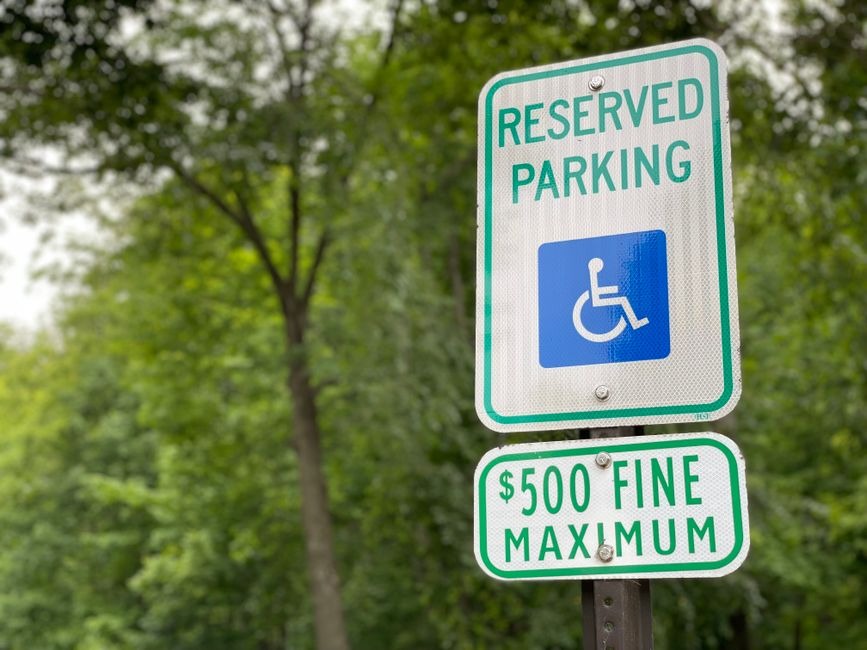
- Physical access starts at the parking lot: One of the most common mistakes is focusing on one visible feature, such as a ramp or an accessible parking sign, while overlooking the rest of the route. A site may have designated accessible parking but no compliant path to the field, playground, trailhead, or restroom. Fix the full route, not just the visible entry point.
- Playground surfacing fails more often than equipment: Surfacing trips up many projects. ASTM International standard ASTM F1951 covers accessibility of surface systems, meaning firmness and stability under a wheelchair. Sand and pea gravel almost always fail.
- Pool lifts must be operable during all open hours: The 2010 ADA Standards provide clear instructions on the number and type of accessible entries required based on the size of the pool. Storing a portable lift in a closet during regular swim hours violates the law.
- Digital accessibility is now a legal obligation: The DOJ’s 2024 final rule on ADA Title II leaves no room for interpretation: all government websites, apps, and digital services must meet WCAG 2.1 Level AA standards by April 2027 (populations 50,000+) or April 2028 (everyone else). This includes park registration pages, event calendars, and facility booking tools.
Quick-Start Prioritization Framework
Use this framework to decide where your department should focus first. The goal is to address the highest-risk gaps before they become complaints or enforcement actions.
Gap | Best Starting Point | Effort Level | Time to Results |
|---|---|---|---|
Missing or outdated transition plan | Self-evaluation + coordinator appointment | Medium | 1-3 months |
Broken accessible routes | Field audit, prioritize by visitor volume | Low-Medium | Weeks |
Non-compliant playground surfacing | Surfacing inspection + maintenance plan | Low | Days to weeks |
Pool lift unavailability | Policy update + equipment check | Low | Days |
Website/digital inaccessibility | WCAG 2.1 AA audit + remediation plan | Medium-High | Months |
Start here if you’re:
- A small parks district: Begin with the transition plan and a field walkthrough of your highest-traffic park. Document every barrier before anything else.
- A mid-size department with multiple facilities: Commission a full accessibility audit that treats routes, surfacing, restrooms, and amenities as one connected system.
- A large department or statewide agency: Use a platform like BlueDAG to centralize inspection data, transition planning, grievance tracking, and remediation in one defensible record.
Mistake 1: Treating the Transition Plan as a One-Time Document
What the law requires
The United States Department of Justice’s regulations implementing Title II of the ADA require local governments to evaluate their services, programs, policies, and practices; identify barriers that may limit accessibility for people with disabilities; and develop transition plans describing how they will address those barriers. That self-evaluation is not a box to check once and file. Transition plans are living documents which must be reevaluated and changed over time to evaluate and include changes in programs and facilities, as well as new or different funding opportunities.
Why departments fall into this trap
Many parks departments completed their original self-evaluation in the early 1990s after the ADA was signed, then never revisited it. Facilities have changed, standards have been updated, and programs have expanded, but the plan has not. Because the Title II regulations and the ADA Standards for Accessible Design changed in 2010, we recommend an updated self-evaluation.
What to do instead
Municipalities must evaluate all programs, services, and activities for ADA compliance. This includes everything from after-school programs offered by the parks and recreation department to sidewalks and transit stops. When you identify barriers, you must develop a plan to fix them, including cost, schedule, and the responsible person or department.
Assign a dedicated ADA coordinator, conduct a fresh self-evaluation of every park and program, and keep the transition plan current as barriers are remediated. BlueDAG’s Government Suite is purpose-built for exactly this: it gives city and county agencies a centralized system to manage self-evaluation, maintain a living transition plan, track barrier remediation, and handle public grievances. If your current plan is sitting in a shared drive collecting dust, that is the first thing to fix.
Pro Tip: Schedule a transition plan review every time your department breaks ground on a new facility, adds a new program, or alters an existing space. Any significant alteration can trigger fresh accessibility obligations under the 2010 standards.
Mistake 2: Auditing Features in Isolation Instead of the Full Accessible Route
The “visible compliance” trap
This is the most common error parks departments make: they install an accessible parking sign, a ramp at the main entrance, and a single accessible restroom stall, then consider the job done. The problem is that ADA compliance requires a continuous accessible experience, not isolated accessible features. Every element in a park or public space should work together to create a continuous, accessible experience. Visitors should be able to move comfortably from parking areas to sidewalks, gathering spaces, playgrounds, shelters, seating areas, and recreational amenities without unnecessary obstacles.
What a compliant route actually looks like
Many well-intentioned park operators and municipal staff assume that if a route is “wider” or if the ground appears “flat enough,” they have met their ADA obligations. The reality is that the Americans with Disabilities Act requires accessible routes to comply with the 2010 ADA Standards for Accessible Design. Technical requirements include specific running-slope limits, cross-slope maximums, clear-width minimums, and surface-stability criteria. A path can look flat but still fail if its cross slope exceeds 2%.
The cost of gaps in the route
The U.S. Department of Justice and the Washington State Parks and Recreation Commission announced a settlement agreement to resolve a complaint that park facilities failed to conform to the Americans with Disabilities Act. The complainant and his spouse reported non-conforming conditions at what was supposed to be a camping space for persons with disabilities. Deep ruts in the camping area resulted in injuries to the complainant, who has mobility issues. A gap in the route is not just a compliance failure; it can cause real physical harm.
Audit your parks from the perspective of a visitor arriving in a wheelchair: from the accessible parking space, along the path to the entrance, through the park to every amenity. BlueDAG’s park accessibility audit framework treats accessible routes, playground surfacing, restrooms, and amenities as one connected system, and prioritizes barriers on the accessible route first.

Mistake 3: Ignoring Playground Surfacing Until Equipment Is Replaced
Why surfacing is the make-or-break issue
When most departments think about playground accessibility, they focus on the play structures themselves. In the field, the accessible route and surfacing are where compliance lives or dies. Every public playground in the United States must meet ADA standards, including an accessible route to the play area, a set ratio of ground-level to elevated play components, and firm, stable safety surfacing.
What fails most often
Wood chips, sand, and pea gravel no longer meet accessibility standards because they aren’t firm enough for wheelchair navigation. Many parks departments installed these materials years ago, assumed they complied, and have not revisited the question. Meanwhile, the surfacing has degraded further. Engineered wood fiber can perform well when installed correctly, compacted, and maintained to ASTM standards, but many sites underbudget maintenance, and the surface degrades around swings, spinners, and slide exits.
Surfaces that meet the standard
Surfacing must meet two separate standards at once, and that trips up many projects. ASTM International standard ASTM F1951 covers surface accessibility, meaning the surface is firm and stable under a wheelchair. ASTM F1292 covers impact attenuation, meaning the surface actually cushions a fall. Materials that meet both include engineered wood fiber, rubber mulch, and poured-in-place rubber.
If your playground has pea gravel or packed sand, assess the surfacing immediately. If it has engineered wood fiber, build a documented maintenance schedule; loose-fill surfaces require routine compaction checks to stay compliant. If you can’t document that the surface meets ASTM F1951 right now, treat it as a barrier in your transition plan.
Pro Tip: Surfacing compliance is not just a design-phase obligation. Maintaining compliance is a continual obligation, not just at installation, but for the lifetime of the playground. Assign maintenance staff to inspect accessible routes and surfacing depth on a monthly basis and log the results.
Mistake 4: Treating Pool Accessibility as Optional or Seasonal
The rule is firm and has been for over a decade
As of May 15, 2012, all public swimming pools in the U.S. must be equipped with assisted entry systems. This is not a new requirement, yet pool lift availability remains one of the most frequently cited failures in parks and recreation enforcement. The primary means of entry must be either a sloped entry into the water or a pool lift that is capable of being independently operated by a person with a disability.
How pool size determines what you need
Any pool with under 300 linear feet of pool wall must provide one means of access, and that means must be either a pool lift or a sloped entry. Any pool with over 300 linear feet of pool wall must provide two means of access, one of which must be either a pool lift or a sloped entry. For large pools, the second means of access can be any of five designated options: pool lifts, sloped entries, transfer walls, transfer systems, or accessible pool stairs.
The operational failure most departments miss
Many parks departments install compliant pool lifts, then store them away to prevent theft or weather damage. That practice is a violation. Accessible pool features must be maintained in operable working condition so persons with disabilities have access whenever the pool is open to others. Locking a lift in a storage room during open swim hours makes the pool inaccessible.
Additionally, the lift must meet technical specifications: to be ADA-compliant, the pool lift must have a minimum weight capacity of 300 lbs. Check your equipment against the full spec list in the U.S. Access Board’s swimming pool guidelines. If the lift is portable, it must be fixed to the deck during operating hours. If it is broken, repair it promptly; an unaddressed equipment failure is a compliance failure.
Pro Tip: Build pool lift inspection into your daily opening checklist. Record the inspection. A written log showing consistent maintenance is far more defensible than verbal assurances if a complaint is filed.
Mistake 5: Overlooking the Administrative Requirements, Coordinator, Grievance Procedure, and Digital Access
The three administrative obligations most departments underestimate
Title II compliance covers far more than ramps and parking lots. Three administrative requirements repeatedly trip up parks departments: designating an ADA coordinator, establishing a grievance procedure, and, increasingly, ensuring digital accessibility.
ADA coordinator and grievance procedure
Local governments with 50 or more employees are required to adopt and publish procedures for resolving grievances arising under Title II of the ADA. Grievance procedures set out a system for resolving disability-discrimination complaints promptly and fairly. Many agencies still treat them as a template, a policy attachment, or a box to check after receiving federal funds. An effective grievance procedure must give people with disabilities a clear path to raise concerns, route complaints quickly to trained decision-makers, and create records that help the entity fix barriers before they become enforcement actions or litigation.
If your department operates under a parent municipality, confirm that the grievance procedure is published, accessible, and actually routes ADA complaints to someone with authority to act on them.
Digital accessibility, the newest compliance frontier
As of April 2024, the Department of Justice released updated regulations for Title II of the Americans with Disabilities Act. This new rule requires all state and local government web and mobile content to meet certain Web Content Accessibility Guidelines. That means your online program registration, facility reservations, event calendars, and any third-party booking tools must meet WCAG 2.1 Level AA standards.
The rule explicitly lists park and recreation districts as covered entities, including their facility booking and program registration systems. For most cities, this change will require significant website upgrades, including third-party credit card processing sites, reservation pages, and privately run mobile parking apps. The compliance deadline is April 2027 for larger jurisdictions, but it’s time to start now.
How BlueDAG Helps Parks Departments Close These Gaps
Parks agencies manage some of the most complex and varied ADA compliance portfolios in government. Trails, playgrounds, restrooms, parking areas, picnic facilities, boat launches, visitor centers, and program facilities each require evaluation against specific accessibility standards. No two facilities are evaluated the same way, and the sheer geographic distribution of parks assets makes traditional inspection methods impractical.
BlueDAG is the complete ADA compliance platform built specifically for government agencies. BlueDAG helps public agencies turn ADA self-evaluations, inspections, transition plans, grievances, and remediation tracking into a living accessibility program. Rather than a static PDF that sits on a shared drive until a complaint arrives, BlueDAG supports the full range of parks compliance work in one platform: self-evaluation by rangers and staff, ADA inspections for complex facilities, virtual pre-inspection for distributed trails and right-of-way, and a transition plan that stays current as work is completed.
Parks agencies like El Dorado Park and Recreation District and Texas Parks and Wildlife have used BlueDAG to move from reactive, report-based compliance to a managed, ongoing program. The Apprentice Mobile App lets inexperienced personnel perform on-site inspections by pointing and clicking through a simple series of questions and taking photos. That means agencies can scale inspections to park rangers, public works crews, or other staff without requiring everyone in the field to complete specialized ADA training.
Frequently Asked Questions
Does Title II of the ADA apply to small parks districts with few employees?
Title II of the ADA applies to all state and local governments and all departments, agencies, special purpose districts, and other instrumentalities of state or local government. There is no size exemption for program access obligations. If a local government or other public entity has fewer than 50 employees, it is not required to appoint an ADA coordinator or establish grievance procedures, but it must still provide accessible programs and remove barriers regardless of staff size.
What happens if a parks department receives an ADA complaint?
Unresolved complaints can be filed directly with the Department of Justice, which can investigate and seek compliance agreements. The U.S. Department of Justice and the Washington State Parks and Recreation Commission reached a settlement agreement to resolve a complaint that park facilities failed to comply with the Americans with Disabilities Act, resulting in a commitment to systematically identify and remediate noncompliant paths, facilities, and structures. Settlement agreements can require multi-year remediation programs and independent monitoring. A documented transition plan and active grievance procedure are your strongest first lines of defense.
Are outdoor trails and natural areas subject to the same ADA rules as buildings?
Natural terrain offers some flexibility in how technical standards apply. Conditional exceptions to compliance exist for terrain that is impractical to modify, situations precluded by federal or state laws such as the Wilderness Act, or cases where removal of a barrier would fundamentally alter the nature of the program or service. However, those exceptions require documented analysis; they are not automatic. The route from parking to key amenities and the connection between accessible trailheads and facilities must still work. Departments that assume outdoor equals exempt take on significant legal risk.
What is an ADA self-evaluation, and does my department need one?
The self-evaluation is a comprehensive review of all programs, activities, and services operated by the public entity. Every public entity covered by Title II must complete one, regardless of size. The self-evaluation identifies policies and practices that may exclude or limit participation by people with disabilities. When conducting the self-evaluation, review each department that interacts with the community; boards and commissions; facilities, curb ramps, intersections, and sidewalks; and the municipality’s employment practices. You should further evaluate all programs, services, and activities to include in the transition plan.
When does the DOJ’s digital accessibility rule take effect for parks departments?
The DOJ’s 2024 final rule requires all government websites, apps, and digital services to meet WCAG 2.1 Level AA standards by April 2027 for jurisdictions with populations of 50,000 or more, or April 2028 for everyone else. Parks departments should begin auditing their websites, third-party booking systems, and program registration platforms now. Waiting until the deadline approaches leaves insufficient time to remediate the code-level issues that typically surface during a proper WCAG audit.
Disclaimer: This article is provided for general informational and educational purposes only and is not intended to constitute legal advice or a legal opinion. While reasonable efforts have been made to provide accurate and current information, laws, regulations, standards, guidance, and interpretations may change, and no representation or warranty is made regarding the accuracy, completeness, or applicability of the information provided. References to tools, resources, or compliance approaches are for informational purposes only and do not guarantee compliance with the Americans with Disabilities Act (ADA) or any other applicable law or regulation. Readers should consult qualified legal counsel or other appropriate professionals regarding their specific circumstances. BlueDAG assumes no liability for any errors or omissions or for actions taken or not taken in reliance on the information contained in this article.
Sources
- ADA Title II Primer for State and Local Governments, U.S. Department of Justice. Overview of Title II obligations for public entities including parks departments. https://www.ada.gov/resources/title-ii-primer/
- ADA Title II Website Compliance for Cities and Towns, Accessibility.Works. Guidance on DOJ's 2024 final rule and WCAG 2.1 AA deadlines for government entities. https://www.accessibility.works/blog/ada-title-ii-2-small-cities-towns-compliance-requirements-guide/
- ADA Rules for Playgrounds, Trails, and Seasonal Recreation, Know-the-ADA. Practical coverage of surfacing, routes, and common compliance failures in outdoor recreation. https://know-the-ada.com/ada-rules-for-playgrounds-trails-and-seasonal-recreation/
- Playground Accessibility Guide, AAA State of Play. Detailed breakdown of ADA route, surfacing, and component requirements for public playgrounds. https://www.aaastateofplay.com/playground-accessibility-guide/
- Chapter 10: Swimming Pools, Wading Pools, and Spas, U.S. Access Board. Technical accessibility standards for aquatic facilities. https://www.access-board.gov/ada/guides/chapter-10-swimming-pools-wading-pools-and-spas/
- ADA Pool Accessibility Requirements, PoolDial. Summary of pool size thresholds and entry requirements under the 2010 Standards. https://www.pooldial.com/resources/articles/business/ada-pool-accessibility-requirements
- ADA Coordinator, Notice and Grievance Procedure, ADA.gov archive. Guidance on coordinator designation and grievance procedure requirements. https://archive.ada.gov/pcatoolkit/chap2toolkit.htm
- ADA Grievance Procedures That Actually Work for Public Entities, Know-the-ADA. Operational guidance on building effective Title II grievance systems. https://know-the-ada.com/ada-grievance-procedures-that-actually-work-for-public-entities/
- "Where You Belong" Online, Increasing Web Equity, National Recreation and Parks Association. Coverage of the DOJ’s 2024 digital accessibility rule and its impact on parks departments. https://www.nrpa.org/blog/where-you-belong-online-increasing-web-equity-and-accessibility-for-all/
- Disability Prevalence, CDC Data, Centers for Disease Control and Prevention. Foundational statistics on disability prevalence across U.S. adults. https://www.cdc.gov/disability-and-health/articles-documents/disabilities-health-care-access.html
- DOJ and Washington State Parks ADA Settlement, U.S. Department of Justice. Case example of enforcement action resulting from parks accessibility failures. https://www.justice.gov/usao-wdwa/pr/us-department-justice-and-washington-state-parks-resolve-complaint-over-americans
- How to Develop an ADA Transition Plan, Kimley-Horn. Guidance on the self-evaluation and transition plan process for municipalities. https://www.kimley-horn.com/news-insights/perspectives/how-to-develop-ada-transition-plan/
- BlueDAG Parks and Recreation, BlueDAG. Platform overview for parks and recreation ADA compliance management. https://www.bluedag.com/parks-and-recreation/
- BlueDAG Solutions, BlueDAG. Government Suite overview including transition planning, grievance management, and inspection workflows. https://www.bluedag.com/solutions.html
- How to Run a Facility Accessibility Audit That Gets Results, BlueDAG. Practical audit framework for parks departments covering routes, surfacing, and amenities. https://www.bluedag.com/how-to-run-a-facility-accessibility-audit-that-gets-results.html